

How Green is a Heat Pump
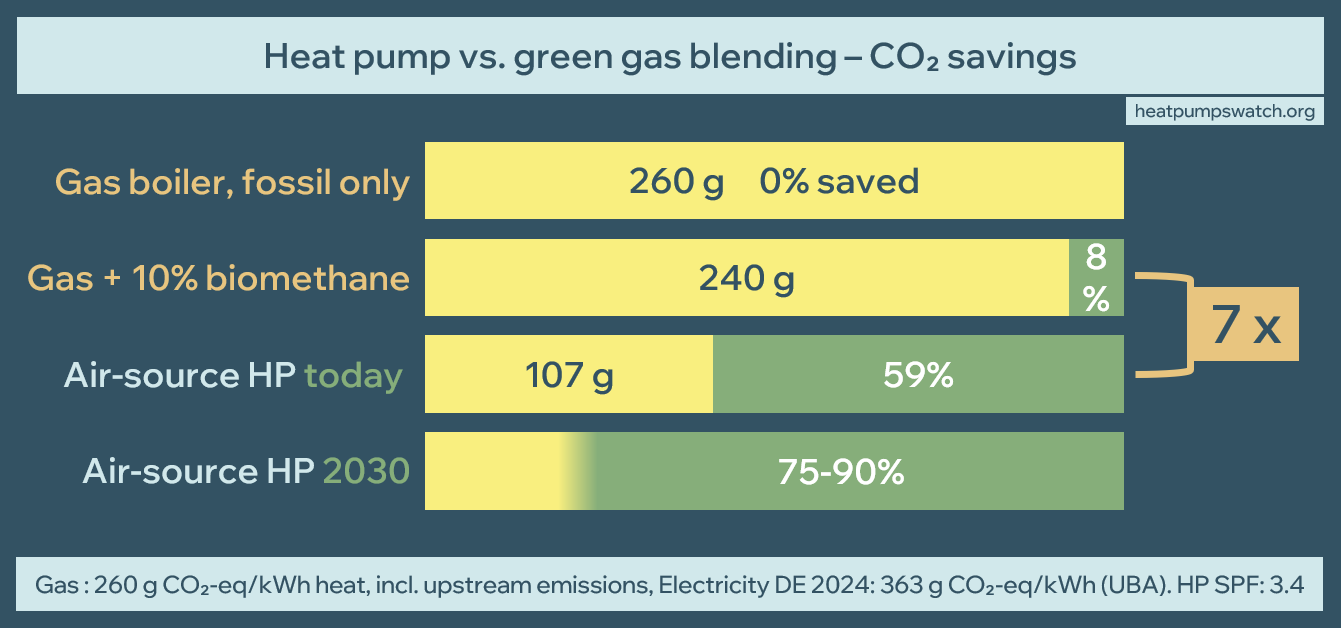
The ecological debate about heat pumps had, in fact, largely been settled in recent years – at least whenever it was conducted on a factual basis. The advantages over fossil heating systems are clearly documented by measurements, and with every new field study the picture has become more consistent. There was little reason to raise the question again.
That has changed. In February 2026, the federal government presented the key points for a new Building Modernization Act (GMG), thereby abolishing the previous 65 percent requirement for renewable energy in new heating systems.1 This is being replaced by a gradual blending of “green gases”—starting in 2029, new gas and oil heating systems must use at least 10 percent CO₂-neutral fuel. This is a good opportunity to revisit the environmental question and perform concrete calculations.
There are several ways to look at this. The most common is the comparison of operating emissions, which asks: How much CO₂ does a heating system emit per kilowatt-hour of heat generated, averaged over a year? A more refined variant is dynamic accounting, which does not use a fixed annual average for the electricity mix, but rather the actual hourly variable emission factor at the respective time the heat pump is in operation.
In addition, there is the so-called TEWI method (Total Equivalent Warming Impact, according to DIN EN 378). It captures the total greenhouse effect over the system’s life cycle and also includes the direct emissions of the refrigerant due to leaks and disposal.
All three levels of analysis lead to the same qualitative result for heat pumps.
The baseline values: Which emission factors are used?
Emissions factors for energy sources can vary significantly depending on the calculation method used—whether only direct combustion emissions or the entire upstream chain (i.e., extraction, processing, and transport) is considered; whether CO₂ alone or CO₂ equivalents including other greenhouse gases such as methane and nitrous oxide are used; and which energy reference unit the calculation is based on. This sometimes makes comparisons difficult. For this article, the following comparable values and accounting boundaries were selected, which apply consistently throughout. All values refer to CO₂ equivalents including the upstream chain and to the kilowatt-hour of heat generated.
Electricity 2024: 363 g CO₂-eq/kWh. This is the current value from the German Federal Environment Agency (UBA) for the German electricity mix in 2024.2 In 1990, this value was still 764 grams; in 2017, it was 489 grams. The decline of more than 50 percent over 34 years reflects the expansion of renewable energy. For 2030, scenarios from the Fraunhofer ISE project a value between 150 and 250 grams3—with correspondingly positive effects on the carbon footprint of all electrically powered systems.
Natural gas, including upstream emissions: approx. 240 g CO₂-eq/kWh of final energy. The net calorific value excluding the upstream chain is approx. 202 g CO₂/kWh—this represents only the direct emissions from combustion. When the upstream chain (extraction, processing, transport, methane leaks) is included, the total value according to IINAS/GEMIS is approx. 237 to 250 g CO₂-eq/kWh.4 In terms of heat generated, a modern gas condensing boiler with a typical annual efficiency of 92 percent results in approximately 260 g CO₂-eq/kWh of heat.
Biomethane (fed into the gas grid): approx. 50 g CO₂-eq/kWh as a representative average. The UBA specifies a range of 8 to 70 grams—depending on the substrate and process control.5 Manure and biowaste achieve very favorable values, but their available quantities are severely limited. If biomethane is to be used on a larger scale, energy crops such as corn must inevitably be utilized, whose emission values are significantly less favorable. The average value of 50 g/kWh used here is already a conservative, gas-friendly assumption.
What Heat Pumps can do Today
A heat pump converts electrical energy into a multiple of heating energy by utilizing ambient heat. The ratio of heat generated to electricity consumed—the seasonal performance factor (SPF)—determines how favorable the CO₂ balance ultimately is. Reliable measurement data is available from a field study conducted by Fraunhofer ISE involving 77 existing systems.3 Air-to-water heat pumps achieve an average COP of 3.4, while ground-source heat pumps achieve 4.3. These are not laboratory values, but measured averages from buildings constructed before 1995, under everyday conditions, over several years.
With an electricity mix of 363 g CO₂/kWh, an air-to-water heat pump with a COP of 3.4 emits around 107 g CO₂-eq/kWh of heat—that is 59 percent less than a gas condensing boiler at 260 g. A ground-source heat pump with a COP of 4.3 emits around 85 g, saving approximately 67 percent. Even the system at the lower end of the measured range, with a COP of 2.6, still emits over 30 percent less than the gas boiler.
What ten percent green gas really delivers
Using the selected emission factors, a mixture of 90 percent natural gas (240 g CO₂-eq/kWh) and 10 percent biomethane (50 g CO₂-eq/kWh) results in a blended fuel with an emissions level of approximately 221 g CO₂-eq/kWh of final energy. In terms of the heat generated—assuming an annual efficiency of 92 percent—this amounts to approximately 240 g CO₂-eq/kWh. The savings compared to pure natural gas amount to approximately 8 percent.
This 8 percent compares to the 59 to 67 percent efficiency that heat pumps already achieve today. The difference corresponds to a factor of seven to eight. It should also be noted that the green gas mandate does not take effect until 2029. Until then, the electricity mix will continue to be decarbonized—so the CO₂ advantage of heat pumps, which directly benefit from this increasingly clean electricity, will be even greater by 2029 than current calculations indicate.
The following table summarizes all relevant heating systems.
| Heating System | g CO₂-eq / kWh Heat | Savings comp. to gas | Trend 2030 |
| Geothermal HP (SPF Ø 4,3) | ca. 85 g | ≈ 67 % | → up to90 % |
| Air-to-water HP (SPF Ø 3,4) | ca. 107 g | ≈ 59 % | → up to88 % |
| Gas-colrific value (reference) | ca. 260 g | – (reference) | no improvement |
| Gas + 10 % biomethane (GMG from 2029 on) | ca. 240 g | ≈ 8 % | dependent on quota |
| Oil-calorific value | ca. 300 g | –15 % (worse) | |
| Direkt power / infrared | ca. 363 g | –40 % (worse) | improves with grid mix |
The Availability Problem
Even if policymakers were to mandate higher blending ratios, the amount of biomethane available in Germany would remain limited. In 2025, approximately 10 TWh of biogas was fed into the gas grid—about 1.2 percent of Germany’s total gas consumption.6 Furthermore, biomethane is even more difficult to substitute in other sectors, such as industry or heavy-duty transportation, than in the building heating sector. Competition for a limited resource will intensify, and scaling up biomethane production will inevitably lead to higher emissions, as energy crops will then dominate.
An Overview of Other Heating Technologies
A comprehensive comparison of all heating technologies based on multiple criteria—economic, technical, and environmental—can be found in Episode 12 of this series. Here, we present the key classifications of the options that are particularly debated from an environmental perspective.
Pellet Heating
Net CO₂ emissions are low because wood is considered a renewable resource. Two significant limitations should be noted here. CO₂ is released immediately upon combustion, while its reabsorption by regrowing forests takes decades. Furthermore, scaling up to the entire German building stock is not feasible due to the severe shortage of sustainable wood resources. In addition, there are significant health impacts. According to the Federal Environment Agency, wood combustion in small-scale combustion plants accounted for 18 percent of Germany’s PM2.5 emissions in 2020—a share comparable in magnitude to that of all road traffic.7
District Heating
CO₂ intensity varies greatly depending on the network—from under 50 g CO₂/kWh in well-decarbonized networks to over 200 g in gas-dominated systems. The decarbonization of district heating networks has been decided at the political level, but the timeline varies significantly by region.
Direct Power and Hydrogen
Direct electric heating systems with an SPF of 1.0 currently emit more than a gas boiler; they improve proportionally with the electricity mix but remain structurally significantly inferior to heat pumps. Hydrogen as a heating fuel loses a significant amount of energy in the conversion chain. Due to losses during electrolysis, transport, and combustion, the Fraunhofer Institute estimates that the demand for renewable electricity to power hydrogen heating systems is five to six times higher than that required for a heat pump.8
Dynamic Accounting and Refrigerants: What the Refined Methods Reveal
The annual accounting method uses a fixed emission factor for the German electricity mix. Dynamic accounting takes a more precise approach by weighting the actual hourly-varying emission factor against the heat pump’s load profile. The result is slightly less favorable because heat pumps tend to run at times when the electricity mix is more emission-intensive than the annual average. Field data from 2023 and 2024 quantify this effect as 10 to 11 percent higher emissions compared to the static method.3 The qualitative finding remains unaffected—the savings compared to the gas boiler were around 57 to 64 percent in the dynamic calculation for 2024.
The TEWI method supplements the operational perspective by accounting for the effect of the refrigerant. Refrigerants that escape into the atmosphere through leaks or during disposal contribute to the overall climate impact as greenhouse gases. However, the TEWI analysis consistently shows that the direct refrigerant contribution for well-maintained heat pumps is about one order of magnitude smaller than the indirect contribution from electricity demand. The efficiency of the system is more relevant to the overall climate balance than the choice of refrigerant.9
The ongoing transition to natural refrigerants such as propane (R290) further improves the LCA. According to the IPCC AR6, R290 has a global warming potential (GWP) of 0.02, making it virtually climate-neutral.10 A detailed overview of refrigerant development and regulation is provided in Episode 16 of this series.
Looking Ahead to 2030: Heat Pumps Improve Automatically
With every further expansion of renewable energy in the power grid, the carbon footprint of a heat pump installed today improves automatically—without any changes needing to be made to the system itself. Fraunhofer ISE scenarios for 2030 project an electricity mix emission factor of 150 to 250 grams of CO₂ per kilowatt-hour.3 This would increase the savings of an air-to-water heat pump compared to a gas boiler to 61 to 83 percent; a ground-source heat pump would achieve 72 to 90 percent.
A new gas heating system does not benefit from this development. Its emissions remain tied to the share of fossil fuels. Even with the green gas step to 30 percent by 2035 as previously envisaged in the GEG, a new gas heating system would remain far more emission-intensive over its entire operating life of 15 to 20 years than a heat pump installed today. Anyone installing a gas heating system today is locking themselves in until around 2040 to 2045 and emitting significantly more CO₂ than with a heat pump.
Conclusion
The environmental benefits of heat pumps were already clear before the current political debate began. Nevertheless, the new key points of the Building Modernization Act make it worthwhile to compare the figures in concrete terms once again. Today, an air-to-water heat pump reduces CO₂ emissions by around 60 percent, while a ground-source heat pump reduces them by around 70 percent. The planned 10 percent green gas blend yields savings of about 8 percent for a gas boiler. Both measures work toward the same goal, but on entirely different scales.
While heat pumps automatically become more efficient with every further expansion of renewable energy, the structural reliance on fossil fuels in gas heating remains unchanged. This article has deliberately excluded financial considerations. It should be noted, however, that green gas rates are already about 25 percent higher than conventional natural gas rates.11 With rising blending ratios and limited biomethane availability, a further significant increase in gas rates is a very likely development. The ecological decision and the economic perspective thus point in the same direction.
The Big Picture: Climate Targets in the Building Sector
Under Germany’s Climate Protection Act, the building sector has a binding emissions target of 67 million metric tons of CO₂ equivalents for 2030—a 50% reduction compared to levels at the start of the 2020s. To achieve this goal, emissions from the heating sector must decrease structurally and rapidly. The magnitude of the difference between a heat pump and a gas heating system with green gas blending is crucial here. At the level of individual buildings, the difference amounts to 8 percent versus 60 to 70 percent CO₂ savings. Multiplied by hundreds of thousands of new heating systems per year and an operational lifespan of 15 to 20 years, this results in cumulative emissions that are incompatible with binding climate targets. A gas heating system installed today will remain in operation until 2040 or 2045—well beyond Germany’s planned path to climate neutrality. The technology installed today and the scale of its deployment will therefore play a decisive role in determining whether climate targets in the building sector remain achievable.
This article is part of our comprehensive series answering the 18 most important questions about heat pump technology. The series is organized into 6 thematic categories. Below you’ll find more articles from the same category, as well as the complete navigation to all other topics.
Foundations & Context
Why heat pumps matter for society, climate, and energy transition. Understand the big picture through social context, myth-busting, environmental impact analysis, and policy evaluation.

Episode 1: Beyond the Noise: What the Heat Pump Truly Means for Our Society
Why heat pumps are the fastest, most cost-effective path to energy independence – beyond political noise and fossil fuel myths.

Episode 4: The Heat Pumps Fact Check: Ten Myths Scientifically Disproven
Ten persistent myths scientifically debunked: heat pumps work in extreme cold, historic buildings, and with existing radiators.

Episode 17: How green is a heat pump
Heat pumps reduce CO₂ emissions by 60-90% compared to gas heating. An environmental analysis.

Episode 18: Are Heat Pump Goals Achievable?
Achieving ambitious heat pump targets: Analysis of technical feasibility, economicviability, and political requirements for climate-neutral heating by 2045.
Technology & Systems
How heat pumps work, different system types, technological evolution, and refrigerant technology. From 20 years of progress to safety of natural refrigerants.
Episode 3: From Niche to Norm: 20 Years of Progress in Heat Pump Technology
Modern heat pumps: 10-15 dB quieter, 20% more efficient, and work up to 70°C—perfect for retrofits.
Episode 7: Hybrid Heat Pump Systems
Analysis reveals: Pure electric heat pumps outperform fossil hybrids in 95% of cases—lower costs, higher efficiency.
Episode 11: Between Air Conditioner and Heating System
Air-to-air heat pumps: lower installation costs, faster deployment, but different comfort level than water-based systems. Systemic comparison.
Episode 12: Heating Technologies Compared
Comprehensive comparison of all heating technologies: heat pumps, gas, hydrogen, biomass, and district heating – pragmatic decision framework.
Episode 16: Refrigerants
Refrigerant evolution: From R410A to natural refrigerants – environmental impact, safety, and efficiency of modern solutions.
Economics & Costs
Operating expenses, installation costs, and long-term financial analysis. Real data on savings, price trends, and return on investment.
Episode 8: Operating Costs: Heat Pumps Already Outperform Gas Heating Systems Today
Save €400-1000/year compared to gas heating today – savings rise to €2,270/year by 2035. Interactive calculator included.
Episode 13: Heat Pump Installation Costs: Germany vs. Europe
German heat pump installations cost €20,000-40,000 – twice the European average. Analysis reveals why and what must change.
Real-World Performance
Field studies, efficiency measurements, and proven results. 20 years of data from 840+ installations in all building types.
Episode 2: 20 Years of Field Studies Prove: Heat Pumps Efficient in Existing Buildings
20 years of field research monitoring 840+ heat pumps in existing buildings. Latest studies show average efficiency (SPF) of 3.4 – even with radiators.
Episode 5: Efficiency Knows no Age: Heat Pumps in Buildings from 1826 to Present Day
6 case studies from 1826-1995: Unrenovated historic buildings achieve SPF 3.5-5.1 with proper planning and hydraulics.
Episode 6: Heat Pumps in Multi-Family Buildings: The Key to Urban Decarbonization
100+ documented cases prove heat pumps work in apartment buildings worldwide – centralized systems to individual units.
Planning & Implementation
Selecting, installing, and optimizing heat pumps for your needs. Practical guides from system sizing to installer selection.
Episode 9: Thousands of Heat Pumps Models on the Market: How to Find the Right One for Me?
Navigate 10,000+ certified heat pump models: Step-by-step guide from heating load calculation to installer selection and system commissioning.
Smart Integration
AI optimization, solar integration, and intelligent energy management. Next-generation heating systems that learn, adapt, and maximize efficiency.
Episode 10: Heat Pumps and AI: A Perfect Match?
AI-controlled heat pumps boost efficiency by 5-13%, reduce costs 40%, and support grid flexibility—research proven.
Episode 14: HEMS: Intelligent Control for Heat Pump Systems
Smart home energy management systems optimize heat pump operation, reduce costs by 15-25%, and enable grid services.
Episode 15: Heat Pumps as Energy Systems
How, with the help of PV, battery storages and electric cars, heat pumps become efficient complete systems. Analysis on savings, own production and bidirectional charging
- Federal Government (2026): Eckpunkte für das Gebäudemodernisierungsgesetz (GMG). Eckpunktepapier der Fraktionsvorsitzenden CDU/CSU und SPD, 24. Februar 2026. ↩︎
- Icha, P. & Lauf, T. (2025): Entwicklung der spezifischen Treibhausgas-Emissionen des deutschen Strommix 1990–2024. Climate Change 13/2025. Umweltbundesamt, Dessau. Value 2024 (preliminary): 363 g CO₂/kWh. ↩︎
- Günther, D. et al. (2025): Fraunhofer ISE Abschlussbericht WP-QS im Bestand. Monitoring von 77 Wärmepumpenanlagen 2021–2024. Funding ID 03EN2029A. Fraunhofer ISE, Freiburg, 31.10.2025. Chapter 5 (SPF-measured values), Chapter 7 (THG-emissions, incl. 2030-scenarios, static and dynamic balancing). ↩︎
- IINAS / Öko-Institut (2023): GEMIS Database 2023. Emission factor for natural gas, including upstream processes (pipeline, Germany): approx. 237–250 g CO₂-eq/kWh. iinas.org. The combustion value excluding upstream processes is approx. 202 g CO₂/kWh and should be understood as a minimum value. ↩︎
- UBA (2023): Emissions Balance of Renewable Energy Sources 2022. Climate Change 49/2023. Federal Environment Agency. Biomethane: 8–70 g CO₂-eq/kWh depending on the substrate (manure: 8–12 g; food waste: 15–25 g; energy crops: 54–70 g). Average value used in the text: 50 g CO₂-eq/kWh. ↩︎
- BDEW, as cited in Polarstern Energie Magazin (2026): Biogas fed into the German gas grid in 2025: approx. 10 TWh ≈ 1.2% of total gas consumption. ↩︎
- UBA (2022): Wood-burning heating systems: Bad for health and the climate. Federal Environment Agency. PM2.5 emissions from wood combustion in small-scale combustion plants in 2020: 18 percent of total national emissions, comparable in magnitude to all road traffic. ↩︎
- Verbraucherzentrale Rheinland-Pfalz (2023): Hydrogen in the boiler room is neither cost-effective nor efficient. Citing calculations by the Fraunhofer Institute, the report states that the demand for renewable electricity for hydrogen heating systems is 5–6 times higher than for heat pumps. ↩︎
- Vering, C. et al. (2022): Kältemittel in Wärmepumpen für die Gebäudeheizung: Ökologische Auswirkungen im gesamten Lebenszyklus. Chemie Ingenieur Technik, 93(10). DOI: 10.1002/cite.202100016. ↩︎
- IPCC AR6 (2021): Sixth Assessment Report, Working Group I. 100-year GWP of propane (R290): 0.02. In accordance with the F-Gas Regulation (EU) 2024/573, Annex VI. ↩︎
- Verivox analysis (2026), cited in energie-fachberater.de (March 2026): Current green gas rates are, on average, about 25 percent higher than conventional natural gas rates. ↩︎