

Are the ambitious Heat Pump Goals achievable?
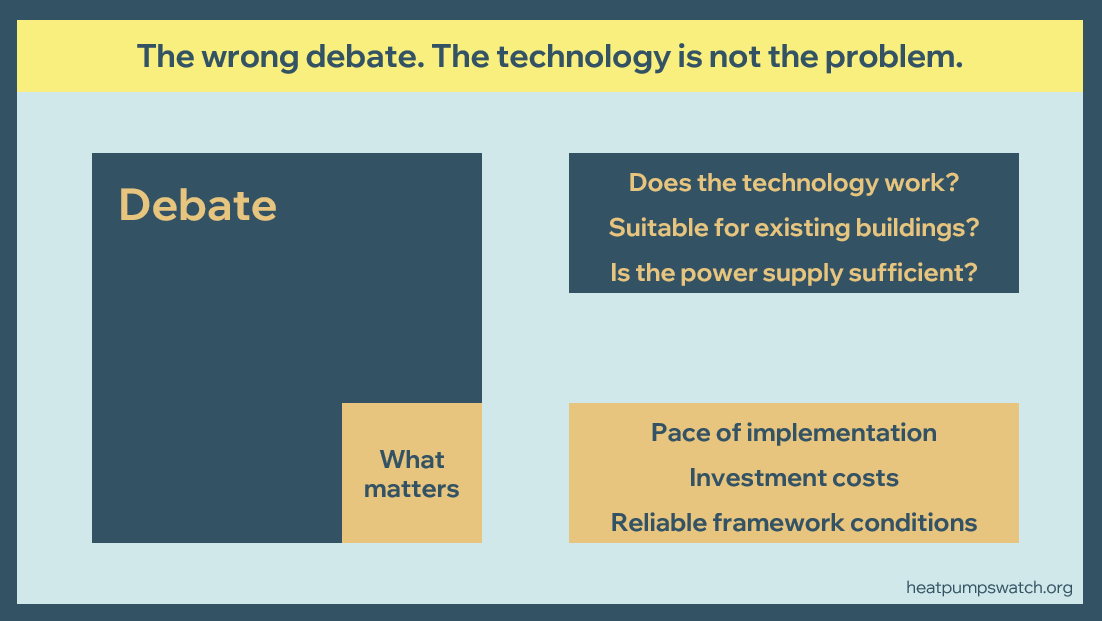
The heat pump is the most efficient, scalable, and climate-effective solution for the heat transition in the building sector. This is not a claim, but the result of extensive scientific evidence compiled, among other things, in this series. The final question now is: Are the ambitious goals even achievable?
The answer is yes. But not by itself.
Goals, Dynamics, and the remaining Gaps
As part of REPowerEU, the EU aims to install approximately 60 million additional heat pumps by 2030, building on an installed base of about 17 million units in 2021.1 In its Net-Zero Scenario, the IEA considers a tripling of global heat pump capacity by 2030 to be necessary.2 Germany had set a goalof having six million heat pumps in operation by 2030.3 Whether this specific target will be pursued under the current political landscape remains to be seen. What is certain: Germany’s climate goals for the building sector still apply, and they cannot be achieved without a massive expansion of heat pump use.
In Germany, a significant recovery took place in 2025. With 299,000 heating heat pumps sold, sales rose by 55 percent compared to the previous year.4 For the first time, the heat pump was the best-selling heating system, ahead of gas heating. 80 percent of the new units were installed in existing buildings. For 2026, the German Heat Pump Association (BWP) expects 410,000 to 530,000 units, depending on the framework conditions.5
This recovery follows a weak 2024, in which sales had fallen to around 193,000 units, primarily due to uncertainty stemming from the political debate over the Building Energy Act and the initially unclear subsidy situation.4 The fact that the market grew so significantly in 2025 despite continued political uncertainty—particularly unresolved questions regarding the future of subsidies and the amendment to the Building Energy Act—speaks to a growing fundamental consumer confidence in the technology itself.
Just under two million heat pumps are currently installed in Germany, out of a total of around 21 million heating systems.4 To reach the original target of six million by 2030, approximately one million units would need to be installed each year in the remaining years. Even 500,000 per year—the frequently cited goal—would not have been sufficient to achieve this.
In Europe, the installed base stands at around 28 million units.6 In 2025, approximately 2.63 million heat pumps were sold across 16 countries, an eleven percent increase following the decline in the previous year.6 The trend is upward, but to meet the REPowerEU goals, the pace would need to increase significantly.
Others have proven that it is possible. Norway has installed 632 heat pumps per 1,000 households (as of the end of 2024), Finland 524, and Sweden 496. Germany stands at 54.7 This disparity reflects not so much a technical limitation as it does untapped potential.
Why Heat Pumps must take on a Central Role
From a technical point of view, heat pumps are universally applicable. Numerous monitoring projects from several European countries over the past 20 years show that air-to-water heat pumps achieve an average annual coefficient of performance of around 3.5 in existing buildings, even when used with radiators and without extensive renovation.8 High-temperature heat pumps now deliver flow temperatures of up to 75 °C.9 The technology works in older buildings (Episodes 2, 5), in apartment buildings (Episode 6), in extreme cold (Episode 3), and in combination with radiators (Episode 4).
Economically, at current energy prices, a heat pump already saves several hundred euros in operating costs per year compared to gas heating (Episode 8).10 This advantage will grow structurally: CO₂ pricing is expected to make fossil fuels more expensive, and recent geopolitical upheavals—from the 2022 energy price crisis to the current gas price hikes—demonstrate how volatile and vulnerable a gas-based heating supply is. However, installation costs in Germany are still well above the European average (Episode 13).11 The reasons are understandable and varied: higher labor costs, more complex installation standards, and a fragmented market. These factors must be systematically addressed. Every heat pump that replaces a gas heating system also reduces dependence on gas imports and strengthens local value creation in skilled trades and industry.
From an environmental perspective, heat pumps currently reduce CO₂ emissions by 60 to 70 percent compared to gas heating, and are expected to reduce them by up to 90 percent by 2030 (Episode 17).12 This happens automatically, without any system retrofitting, simply through the decarbonization of the power grid. No other heating technology passively improves its carbon footprint over its lifespan.
Systemically, the heat pump is unique among heating technologies as a flexible consumer in the energy system of the future: it can be controlled via dynamic rates, integrated into the PV-storage-electric-vehicle network, and coordinated via home energy management systems (Episodes 10, 14, 15).13 This flexibility makes it not just a heating device, but an active component of the energy transition.
What Alternatives are available?
In addition to the heat pump, other technologies are regularly cited as solutions for the heating transition. A systematic look at their capabilities and limitations is worthwhile.
Hydrogen for heating is rejected as a solution for building heating by 54 independent scientific studies; not a single one recommends it as the preferred option.14 The reason is physical: producing, transporting, and burning hydrogen requires six to eight times as much electricity as a heat pump that delivers the same amount of heat. This inefficiency cannot be overcome by technological progress, as it is rooted in thermodynamics. There are also practical hurdles: The infrastructure for widespread hydrogen distribution does not exist and would be extremely costly to build. The limited quantities of green hydrogen that will be available in the coming years are more urgently needed in industry and heavy-duty transportation—sectors that have no electric alternative (Episode 1).
Biomethane is not a solution in terms of volume. The amount available in Germany is around 10 TWh, which corresponds to roughly 1 percent of gas consumption.12 When blended at a rate of 10 percent, the CO₂ emissions from a gas boiler are reduced by only about 8 percent, compared to 60 to 70 percent with a heat pump (Episode 17). Here, too, the following applies: Industry and heavy-duty transport have no electric alternative and need green gas more urgently than the building sector, which does have one.
Biomass is not scalable. Forest resources are limited, and around 18 percent of PM2.5-emissions in the European building sector come from biomass combustion.15
District Heating is an important supplement in densely built-up urban areas (Episode 6). But it cannot equip individual buildings across the board and is itself increasingly powered by large-scale heat pumps. It is not an alternative model, but a complementary application of the same technology.
In summary: Each of these alternatives has its place in specific applications. But none of them can assume the role required for comprehensive decarbonization of the carbon sector.
Are the supposed Obstacles Real?
In public debate, arguments are regularly put forward that call into question the feasibility of meeting heat pump goals. Upon closer examination, most of these prove to have already been overcome or are well on their way to being resolved.
“Production capacity is insufficient.” European manufacturers have invested around seven billion euros in new factories and production lines in recent years. The cumulative production capacity significantly exceeds the installation targets. The shift to fully automated manufacturing also points to falling production costs.9
“There are not enough skilled workers.” According to a 2020 assessment by the BWP, only about 15 percent of German HVAC companies were installing heat pumps at that time. A representative ZVSHK survey from 2023 shows that more than 80 percent of such companies in Germany are now capable of doing so.9 The number of participants in training courses for “Experts in Heat Pump Systems according to VDI 4645” rose from 176 (2020) to 3,945 (2023).9 New national providers also offer standardized installation processes within a few weeks.9 All these developments have significantly alleviated the skilled labor shortage. However, there is no doubt that the transition of installers from gas and oil technology to heat pumps must continue to be consistently driven forward.
“It does not work in existing buildings or in apartment buildings.” Numerous monitoring projects show that heat pumps in existing buildings achieve efficiency levels more than sufficient for economical operation, even without extensive renovation (Episodes 2, 5). 80 percent of all heat pumps sold in Germany in 2025 were installed in existing buildings.4 In France, the share of heat pumps in new multi-family buildings rose from 4 to 45 percent within five years (Episode 6).16 More standardization is needed here; this is a legitimate challenge, not a fundamental obstacle.
“It’s not cost-effective.” At current energy prices, a heat pump already saves several hundred euros per year compared to gas heating (Episode 8).10 New business models, such as the integration of PV, storage, e-mobility, and smart energy management, further improve the business case and make the heat pump the core of an energy system rather than just a heating device (Episodes 14, 15).13 Furthermore, the first financing and contracting models are emerging that spread the high initial investment over monthly installments, thereby lowering the barrier to entry for broader segments of the population.
What Framework Conditions still need to be established?
The heat transition is not failing because of the technology itself. However, there are framework conditions that can either accelerate or slow down its rollout. Four of these are particularly relevant.
First: Create reliable framework conditions. The political uncertainty surrounding the Building Energy Act 2023/2024 caused sales to plummet, not because the technology failed, but because investor confidence was destroyed.4 The year 2025 illustrates both sides of this dynamic. The heat pump has established itself as a technology and was the best-selling heating system for the first time. At the same time, total sales of heating systems fell to their lowest level in 15 years because many homeowners are waiting until there is clarity about future regulations.4 Anyone who buys a heating system is making a decision for 15 to 20 years. Such decisions require planning certainty.
Second: Improve the electricity-to-gas price ratio. In Germany, the ratio is about 3:1; electricity costs three times as much as gas per kilowatt-hour. With typical efficiency levels, this already results in a running cost advantage over gas heating, but it is not yet large enough to amortize the higher investment costs over an acceptable timeframe.9 In the Nordic countries, the ratio is close to 2:1. There, the heat pump market share is 40 to 60 percent, compared to 15 percent in Germany.9 There are several levers to adjust: electricity taxes, grid fees, surcharges on heat pump electricity, and CO₂ pricing for fossil fuels, which will gain further momentum with the EU Emissions Trading System for Buildings and Transport (ETS2) starting in 2027. In countries that have already adjusted these levers, heat pump sales have demonstrably increased.6
Third: Reduce installation costs. In Germany, homeowners pay between 20,000 and 40,000 euros for a heat pump installation (Episode 13).11 The causes have been identified: higher labor costs, more complex installation standards, a fragmented market, and less standardization. Each individual factor can be addressed. Even a reduction of around 25 percent would significantly shorten the payback period and make the decision much easier for many homeowners.
Fourth: Promote standardization in multi-family buildings. Technical feasibility has been demonstrated (Episode 4). However, scaling up requires standardized solutions that can be applied to different building types, particularly in the urban building stock.
These four tasks are primarily political and regulatory in nature, with the exception of standardization, which also requires technical development work. However, none of them fundamentally calls into question the feasibility of the heating transition.
Conclusion and Call to Action
The heat pump is technically mature, economically competitive, environmentally superior, and uniquely versatile. There is no alternative that can keep pace at the required scale. The supposed obstacles—production capacity, skilled workers, and retrofitting existing buildings—have largely been overcome. What is missing are the right framework conditions: a fair electricity-to-gas price ratio, political reliability, lower installation costs, and greater standardization in multi-family homes. None of this is unattainable.
Today, heat pumps reduce CO₂ emissions by 60 to 70 percent compared to gas heating. By 2030, this figure is expected to reach up to 90 percent without any changes to the system.12 The power grid is becoming cleaner every year, and heat pumps automatically benefit from this. No technology based on combustion—whether gas, oil, biomass, or biomethane—can achieve this. Those who burn fuel today will still be burning it in 20 years. Those who electrify today will become cleaner every year.
Waiting is not a neutral decision. Every gas heating system installed today instead of a heat pump ties a household to fossil fuels for 15 to 20 years—that is, until 2040 or 2045, the target year for climate neutrality. Europe imports around 90 percent of its gas.17 Every heat pump that replaces a gas heating system strengthens energy independence. Every month of delay widens the gap to climate goals.
There are unresolved issues regarding the standardization of complex buildings, installation costs, the comprehensive transition to natural refrigerants (Episode 9), and the integration of AI into all phases of a heat pump’s lifecycle (Episode 16). But the technology is mature, the evidence is extensive, and the direction is clear. Waiting until everything is perfectly resolved means acting too late.
We should not use heat pumps because they are politically subsidized or because a law requires it. We should use them because they are the most efficient, scalable, and climate-effective solution for the heating transition in the building sector. The facts are clear. Now it is time to act.
This article is part of our comprehensive series answering the 18 most important questions about heat pump technology. The series is organized into 6 thematic categories. Below you’ll find more articles from the same category, as well as the complete navigation to all other topics.
Foundations & Context
Why heat pumps matter for society, climate, and energy transition. Understand the big picture through social context, myth-busting, environmental impact analysis, and policy evaluation.

Episode 1: Beyond the Noise: What the Heat Pump Truly Means for Our Society
Why heat pumps are the fastest, most cost-effective path to energy independence – beyond political noise and fossil fuel myths.

Episode 4: The Heat Pumps Fact Check: Ten Myths Scientifically Disproven
Ten persistent myths scientifically debunked: heat pumps work in extreme cold, historic buildings, and with existing radiators.

Episode 17: How green is a heat pump?
Heat pumps reduce CO₂ emissions by 60-90% compared to gas heating. An environmental analysis.

Episode 18: Are Heat Pump Goals Achievable?
Achieving ambitious heat pump goals: Analysis of technical feasibility, economicviability, and political requirements for climate-neutral heating by 2045.
Technology & Systems
How heat pumps work, different system types, technological evolution, and refrigerant technology. From 20 years of progress to safety of natural refrigerants.
Episode 3: From Niche to Norm: 20 Years of Progress in Heat Pump Technology
Modern heat pumps: 10-15 dB quieter, 20% more efficient, and work up to 70°C—perfect for retrofits.
Episode 7: Hybrid Heat Pump Systems
Analysis reveals: Pure electric heat pumps outperform fossil hybrids in 95% of cases—lower costs, higher efficiency.
Episode 11: Between Air Conditioner and Heating System
Air-to-air heat pumps: lower installation costs, faster deployment, but different comfort level than water-based systems. Systemic comparison.
Episode 12: Heating Technologies Compared
Comprehensive comparison of all heating technologies: heat pumps, gas, hydrogen, biomass, and district heating – pragmatic decision framework.
Episode 16: Refrigerants
Refrigerant evolution: From R410A to natural refrigerants – environmental impact, safety, and efficiency of modern solutions.
Economics & Costs
Operating expenses, installation costs, and long-term financial analysis. Real data on savings, price trends, and return on investment.
Episode 8: Operating Costs: Heat Pumps Already Outperform Gas Heating Systems Today
Save €400-1000/year compared to gas heating today – savings rise to €2,270/year by 2035. Interactive calculator included.
Episode 13: Heat Pump Installation Costs: Germany vs. Europe
German heat pump installations cost €20,000-40,000 – twice the European average. Analysis reveals why and what must change.
Real-World Performance
Field studies, efficiency measurements, and proven results. 20 years of data from 840+ installations in all building types.
Episode 2: 20 Years of Field Studies Prove: Heat Pumps Efficient in Existing Buildings
20 years of field research monitoring 840+ heat pumps in existing buildings. Latest studies show average efficiency (SPF) of 3.4 – even with radiators.
Episode 5: Efficiency Knows no Age: Heat Pumps in Buildings from 1826 to Present Day
6 case studies from 1826-1995: Unrenovated historic buildings achieve SPF 3.5-5.1 with proper planning and hydraulics.
Episode 6: Heat Pumps in Multi-Family Buildings: The Key to Urban Decarbonization
100+ documented cases prove heat pumps work in apartment buildings worldwide – centralized systems to individual units.
Planning & Implementation
Selecting, installing, and optimizing heat pumps for your needs. Practical guides from system sizing to installer selection.
Episode 9: Thousands of Heat Pumps Models on the Market: How to Find the Right One for Me?
Navigate 10,000+ certified heat pump models: Step-by-step guide from heating load calculation to installer selection and system commissioning.
Smart Integration
AI optimization, solar integration, and intelligent energy management. Next-generation heating systems that learn, adapt, and maximize efficiency.
Episode 10: Heat Pumps and AI: A Perfect Match?
AI-controlled heat pumps boost efficiency by 5-13%, reduce costs 40%, and support grid flexibility—research proven.
Episode 14: HEMS: Intelligent Control for Heat Pump Systems
Smart home energy management systems optimize heat pump operation, reduce costs by 15-25%, and enable grid services.
Episode 15: Heat Pumps as Energy Systems
How, with the help of PV, battery storages and electric cars, heat pumps become efficient complete systems. Analysis on savings, own production and bidirectional charging
- European Commission (2022): REPowerEU: Joint European Action for More Affordable, Secure and Sustainable Energy. COM(2022) 230 final. ↩︎
- International Energy Agency (2021): Net Zero by 2050: A Roadmap for the Global Energy Sector. IEA, Paris.. ↩︎
- Federal Ministry for Economy and Climate Protection (2022): Wärmepumpengipfel 2022: Ziel von sechs Millionen installierten Wärmepumpen bis 2030. BMWK, Berlin. ↩︎
- Bundesverband Wärmepumpe (2026): Über 50 Prozent im Plus: Wärmepumpen-Absatz steigt 2025 deutlich. BWP-Press Release, 27.01.2026. ↩︎
- Bundesverband Wärmepumpe (2025): Wärmepumpenmarkt wächst: BWP hebt Branchenprognose beim FORUM Wärmepumpe an. BWP-Press Release, 28.11.2025. ↩︎
- European Heat Pump Association (2026): Heat Pump Sales Testify to Government Action. EHPA-Pressemitteilung, März 2026. ↩︎
- European Heat Pump Association (2025): Heat Pump Sales 14 Times Greater in Lead Countries. EHPA Market Report 2025. ↩︎
- Miara, M. (2026): Are the Ambitious Heat Pump Targets Achievable? In: Proceedings of the 15th IEA Heat Pump Conference 2026, Wien. ↩︎
- Miara, M. (2026): Are the Ambitious Heat Pump Targets Achievable? 15th IEA Heat Pump Conference 2026. (Detailed data on production capacity, skilled workers, feedwater temperatures, and the electricity-to-gas price ratio.) ↩︎
- Heat Pumps Watch (2026): Heating Technologies Compared. https://heatpumpswatch.org/heating-technologies-compared/. ↩︎
- Heat Pumps Watch (2026): Heat Pump Installation Costs. https://heatpumpswatch.org/heat-pump-installation-costs-germany-vs-europe/ ↩︎
- Heat Pumps Watch (2026): How Green is a Heat Pump. https://heatpumpswatch.org/how-green-is-a-heat-pump/ ↩︎
- Heat Pumps Watch (2026): Heat Pumps as Energy System. https://heatpumpswatch.org/heat-pumps-as-energy-systems/ ↩︎
- Rosenow, J. (2024): A Meta-Review of 54 Studies on Hydrogen Heating. Cell Reports Sustainability, 1, 100010. ↩︎
- European Climate Foundation (2022): The Building Emissions Problem. ECF, Brussels. ↩︎
- Bati Etude Observatoire (2025): Observatoire – Share of heat pumps in French newly-built multi-family buildings. ↩︎
- EHPA (2025): European Heat Pump Market Report 2025 – Executive Summary. ↩︎