

Heat Pump Refrigerants
The refrigerant circulates inside every heat pump and performs the actual transfer of heat – a technically indispensable component that has changed fundamentally over recent decades: from ozone-depleting CFCs to climate-impacting HFCs and on to natural alternatives such as propane. Which refrigerant a system uses affects efficiency, environmental impact and safety – making it more relevant to the buying decision than it might initially appear.
A heat pump consists of four components: evaporator, compressor, condenser, and expansion valve. The substance that circulates through all four and actually transports the heat is the refrigerant.
Certain refrigerants have proven to be environmentally problematic in the past and have triggered global regulatory processes – but they have also shown that the industry is capable of adapting. The forced phase-out of ozone-depleting CFCs in the 1990s is one of the few examples where global regulatory intervention has had a measurable effect: the ozone layer is demonstrably recovering.1 Today, another change is on the horizon.
What a Refrigerant Does
The refrigerant is the substance that circulates in a heat pump and enables heat transfer. Its boiling point is crucial: water evaporates at 100 degrees Celsius, while other substances evaporate at minus 40 degrees or below. This is precisely what makes them refrigerants.
When a liquid evaporates, it absorbs heat from its surroundings. A refrigerant with a low boiling point can absorb heat even from cold outside air – outside air at minus ten degrees Celsius is warm enough for such a refrigerant to trigger the phase transition. In the evaporator, the liquid refrigerant absorbs this heat and evaporates. The compressor increases the pressure of the gas and thus its temperature. In the condenser, it releases the heat to the heating water and becomes liquid again. Finally, the expansion valve lowers the pressure, cools the refrigerant – and the cycle begins again.
A Short History of Refrigerants
Refrigerants usually have a chemically complex name and an abbreviation beginning with the letter R – for refrigerant. R410A, R32, R290: These designations follow a standardized system that provides information about the chemical composition. In everyday life, it is sufficient to know the abbreviation – it is printed on the type plate of every heat pump and forms the basis of all regulatory requirements.
Pioneering Days: Natural but Dangerous Substances
Early refrigeration technology in the 19th century used natural substances: ammonia, sulfur dioxide, carbon dioxide. These substances are thermodynamically efficient – ammonia is still used in industrial refrigeration systems today. The problem was that they were dangerous: ammonia is toxic, sulfur dioxide is highly corrosive, and carbon dioxide requires very high operating pressures.
The Supposed Breakthrough: CFCs
In 1930, an American chemist presented a new substance at a trade conference that was supposed to make everything better. He demonstrated its harmlessness by inhaling a lungful of it and extinguishing a candle with it. The newly developed synthetic refrigerants – known at the time under the brand name Freon – seemed to be the perfect solution: chemically stable, non-flammable, non-toxic, and technically easy to handle.
Their chemical stability became an ecological problem: these substances rise into the upper atmosphere, where they destroy the ozone layer. This mechanism was scientifically proven in the 1970s2, and the growing ozone hole over Antarctica was documented in 19853. The Montreal Protocol of 1987 mandated a global phase-out; today it is considered one of the most effective environmental agreements in history.
Ozone-friendly, but Harmful to the Climate
CFCs were replaced by substances that no longer contained chlorine and did not attack the ozone layer. This solved one problem – but the next one followed: their global warming potential is considerable. A widely used refrigerant of this generation, R410A, is over 2,000 times more potent than CO₂ per kilogram. This property was only fully understood after its widespread introduction.
Refrigerants Compared: Climate Impact and Regulation
The ozone problem of the CFC era is now considered solved. The decisive parameter today is global warming potential (GWP). It describes how much one kilogram of a substance warms the climate compared to one kilogram of CO₂ over 100 years. The EU has drawn conclusions from this: the F-Gas Regulation sets a GWP limit of 150 for new heat pumps up to 12 kW from 20274. R410A and R32 – the previous standard refrigerants – significantly exceed this value. Existing systems may continue to be operated.
The latest generation of synthetic refrigerants, known as HFOs, have very low GWP values and would meet the limit. Their problem lies elsewhere: they decompose in the atmosphere into trifluoroacetic acid (TFA) – a substance that is extremely persistent and hardly biodegradable5. Scientific studies show that its concentrations in rain, soil, and drinking water are increasing irreversibly6. This debate could narrow the approval window for HFOs more than their low GWP values would suggest.7
| Refrigerant | GWP | EU Status from 2027 on |
| R410A | 2,088 | No new admission in HPs up to 12 kW |
| R32 | 675 | No new admission in HPs up to 12 kW |
| HFOs | 1–10 | Permitted ; TFA controversy |
| R290 (Propane) | < 0,1 | Permitted; meets all requirements |
Propane (R290): Characteristics, Advantages, Safety
Propane is a natural hydrocarbon that has been used in refrigeration technology for decades. As a refrigerant, it is used in a highly pure form – with a purity of over 99.5 percent, free of moisture and other hydrocarbons. Only in this quality does it deliver the thermodynamic properties that a heat pump needs for efficient and safe operation. As a refrigerant in heat pumps, it has a decisive advantage over synthetic alternatives: it has virtually no greenhouse gas effect and thus meets the EU requirements applicable from 2027 without restrictions. Propane is well suited thermodynamically. It efficiently absorbs heat even at low outside temperatures and operates at moderate pressures. Studies show that R290 heat pumps achieve comparable or slightly better efficiency values in heating mode than systems with synthetic refrigerants 8,9,10. A practical advantage: propane appliances achieve maximum flow temperatures of 70°C on average, with some models even reaching 80°C – significantly more than R32 or R410A systems, which typically reach 60°C. This makes propane heat pumps suitable for older buildings with higher heating system temperatures.11
The Challenge: Flammability
According to European standard EN 378, propane belongs to safety class A3 – highest flammability, low toxicity. This influences the design and installation in several ways.12
Today, propane heat pumps are mainly built as so-called monoblock units: the entire refrigerant system – compressor, heat exchanger, and all pipes – is located in a single outdoor unit. Only water pipes lead into the building. This greatly simplifies the safety requirements because any leak in the outside air is immediately diluted and no concentration can build up indoors.
In so-called split systems, where the indoor and outdoor units are connected by refrigerant pipes, it is more difficult to ensure that these requirements are met. The amount of refrigerant that may be used in the building is limited by standards. For this reason, the monoblock has become the standard concept for propane heat pumps in residential buildings.
No Fear but Respect
The refrigeration cycle of a heat pump is a hermetically sealed, permanently installed system. The refrigerant circulates continuously within it without coming into contact with the environment. Residents never come into contact with it.
Refrigerant in a heat pump is not a consumable. It is not used up, does not need to be refilled, and remains in the system permanently under normal operating conditions. This applies to residential buildings – the technology is different for large industrial refrigeration systems.
To put the fill quantities into perspective: a standard propane cylinder for barbecues or camping stoves contains 5 to 11 kilograms of gas. The refrigerant filling quantity of a heat pump for a single-family home is typically between 0.5 and 2.5 kilograms. Current research projects – and the first series products – already manage with less than 150 grams.13
Propane is flammable, but only ignites in the air within a certain concentration range. However, this is only relevant if gas actually escapes. For this to happen, the hermetic system would first have to fail, allowing the gas to accumulate in sufficient concentration in a room, and then an ignition source would have to be present. Heat pumps are equipped with various active and passive safety mechanisms to prevent this from happening. If systems are installed and maintained correctly, dangerous situations are highly unlikely. There are no known increased accident rates for R290 systems compared to systems with non-flammable refrigerants.
What combustibility requires is not special caution during operation, but care during installation and maintenance. Both must be carried out by certified specialists – this is required by law and is no different from other refrigerants.
To clarify: millions of European households have gas heating systems that burn natural gas on a daily basis during normal operation – a substance that is also flammable and would also be volatile and odorless if no warning agent were added. Propane in a heat pump, on the other hand, is never burned and never released. Technically, these two risks are not comparable.
The Market is Changing: What Certification Data Shows
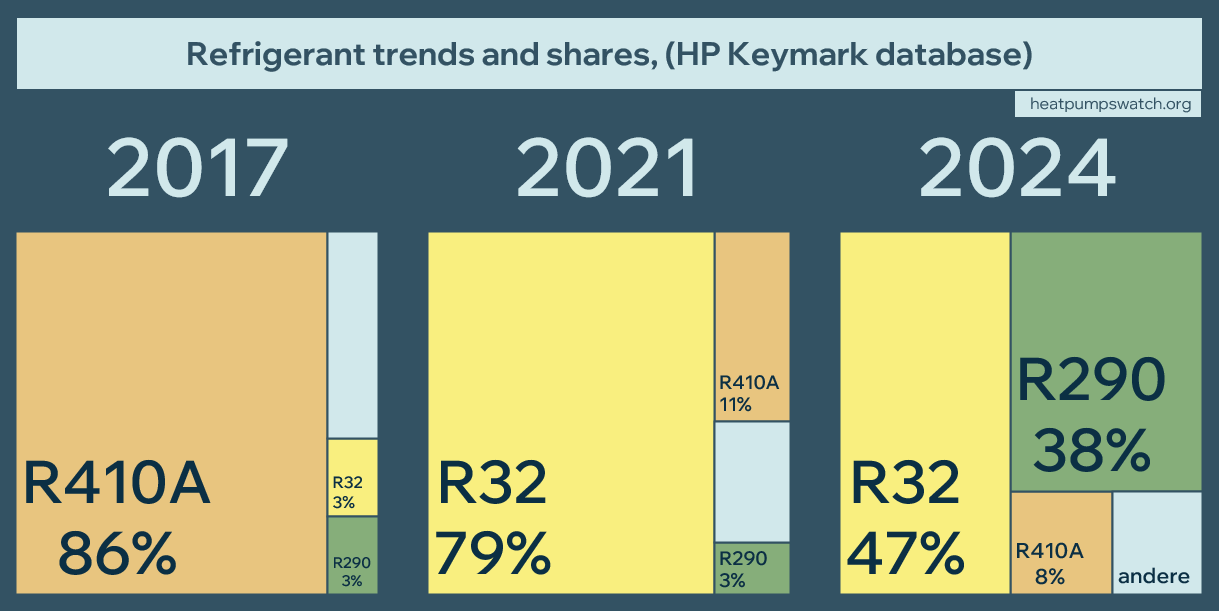
Market data shows how quickly the industry is actually moving. An evaluation of 2,443 heat pump models from the European certification register paints a clear picture of the refrigerant transition: in 2016/17, over 80 percent of newly certified heat pumps still used R410A. From 2018, R32 began to replace R410A, reaching a peak share of 79 percent in 2021. Since then, a second wave has been taking place: propane has risen steadily since 2022 and already accounted for 38 percent of new certifications in 2024.
Another trend is linked to the thermodynamic properties of propane: The maximum flow temperatures of certified models have risen from an average of 57°C to 62°C since 2017 – the reason for this is the increasing use of propane. The refrigerant therefore has less of an impact on efficiency levels than on the range of applications: heat pumps are becoming accessible to more buildings thanks to the switch to R290.
What that Means for the Buyer
The refrigerant does not have to be a purchasing decision – but it can be. Every heat pump approved today will be able to run smoothly for the next 20 years. Choosing propane is generally a good and future-proof choice.
Propane systems will meet the EU requirements applicable from 2027 without any modifications. Systems using other approved refrigerants will remain legally permissible as long as they are in operation. European manufacturers have now largely established their product lines with natural refrigerants; many suppliers – especially those from Asian countries – are still in transition. Propane systems currently cost around 10 to 15 percent more than equivalent devices with synthetic refrigerants – due to more complex safety components.14 However, these systems are rapidly becoming the standard, the safety technology is mature, and the price differences will no longer be significant in the coming years.
Summary
The history of refrigerants is a history of learning: new substances solved real problems—and brought with them new obstacles, to which science and regulatory authorities responded. Today, with 21st-century safety standards and manufacturing precision, the industry is returning to natural refrigerants, which were used at the dawn of refrigeration technology.
Propane combines thermodynamic suitability, minimal climate impact, and global availability. Its flammability can be constructively controlled thanks to decades of experience in refrigeration technology. The key factor here is that the refrigeration circuit is hermetically sealed – this is the most important feature of the system: no contact, no intervention, no maintenance required for residents. The F-Gas Regulation sets the regulatory framework: from 2027, only refrigerants with a GWP below 150 will be permitted in new systems. The market is already moving in this direction.
One thing deserves clarification in conclusion: every heat pump with a refrigerant approved today is far superior to a gas boiler in terms of its overall ecological balance. The refrigerant contributes to the climate balance to a small extent – the decisive factor is the electricity used to operate the heat pump. Its climate impact decreases with every percentage point of renewable energy in the grid.
This article is part of our comprehensive series answering the 18 most important questions about heat pump technology. The series is organized into 6 thematic categories. Below you’ll find more articles from the same category, as well as the complete navigation to all other topics.
Technology & Systems
How heat pumps work, different system types, technological evolution, and refrigerant technology. From 20 years of progress to safety of natural refrigerants.

Episode 3: From Niche to Norm: 20 Years of Progress in Heat Pump Technology
Modern heat pumps: 10-15 dB quieter, 20% more efficient, and work up to 70°C—perfect for retrofits.

Episode 7: Hybrid Heat Pump Systems
Analysis reveals: Pure electric heat pumps outperform fossil hybrids in 95% of cases—lower costs, higher efficiency.

Episode 11: Between Air Conditioner and Heating System
Air-to-air heat pumps: lower installation costs, faster deployment, but different comfort level than water-based systems. Systemic comparison.

Episode 12: Heating Technologies Compared
Comprehensive comparison of all heating technologies: heat pumps, gas, hydrogen, biomass, and district heating – pragmatic decision framework.

Episode 16: Refrigerants
Refrigerant evolution: From R410A to natural refrigerants – environmental impact,
safety, and efficiency of modern solutions.
Foundations & Context
Why heat pumps matter for society, climate, and energy transition. Understand the big picture through social context, myth-busting, environmental impact analysis, and policy evaluation.
Episode 1: Beyond the Noise: What the Heat Pump Truly Means for Our Society
Why heat pumps are the fastest, most cost-effective path to energy independence – beyond political noise and fossil fuel myths.
Episode 4: The Heat Pumps Fact Check: Ten Myths Scientifically Disproven
Ten persistent myths scientifically debunked: heat pumps work in extreme cold, historic buildings, and with existing radiators.
Episode 17: How green is a heat pump?
Heat pumps reduce CO₂ emissions by 60-90% compared to gas heating. An environmental analysis.
Episode 18: Are Heat Pump Goals Achievable?
Achieving ambitious heat pump targets: Analysis of technical feasibility, economicviability, and political requirements for climate-neutral heating by 2045.
Economics & Costs
Operating expenses, installation costs, and long-term financial analysis. Real data on savings, price trends, and return on investment.
Episode 8: Operating Costs: Heat Pumps Already Outperform Gas Heating Systems Today
Save €400-1000/year compared to gas heating today – savings rise to €2,270/year by 2035. Interactive calculator included.
Episode 13: Heat Pump Installation Costs: Germany vs. Europe
German heat pump installations cost €20,000-40,000 – twice the European average. Analysis reveals why and what must change.
Real-World Performance
Field studies, efficiency measurements, and proven results. 20 years of data from 840+ installations in all building types.
Episode 2: 20 Years of Field Studies Prove: Heat Pumps Efficient in Existing Buildings
20 years of field research monitoring 840+ heat pumps in existing buildings. Latest studies show average efficiency (SPF) of 3.4 – even with radiators.
Episode 5: Efficiency Knows no Age: Heat Pumps in Buildings from 1826 to Present Day
6 case studies from 1826-1995: Unrenovated historic buildings achieve SPF 3.5-5.1 with proper planning and hydraulics.
Episode 6: Heat Pumps in Multi-Family Buildings: The Key to Urban Decarbonization
100+ documented cases prove heat pumps work in apartment buildings worldwide – centralized systems to individual units.
Planning & Implementation
Selecting, installing, and optimizing heat pumps for your needs. Practical guides from system sizing to installer selection.
Episode 9: Thousands of Heat Pumps Models on the Market: How to Find the Right One for Me?
Navigate 10,000+ certified heat pump models: Step-by-step guide from heating load calculation to installer selection and system commissioning.
Smart Integration
AI optimization, solar integration, and intelligent energy management. Next-generation heating systems that learn, adapt, and maximize efficiency.
Episode 10: Heat Pumps and AI: A Perfect Match?
AI-controlled heat pumps boost efficiency by 5-13%, reduce costs 40%, and support grid flexibility—research proven.
Episode 14: HEMS: Intelligent Control for Heat Pump Systems
Smart home energy management systems optimize heat pump operation, reduce costs by 15-25%, and enable grid services.
Episode 15: Heat Pumps as Energy Systems
How, with the help of PV, battery storages and electric cars, heat pumps become efficient complete systems. Analysis on savings, own production and bidirectional charging
- World Meteorological Organization (WMO) (2025): WMO Ozone Bulletin 2025. Published September 2025. Online accessible via: https://wmo.int ↩︎
- Molina, M. J.; Rowland, F. S. (1974): Stratospheric sink for chlorofluoromethanes: chlorine atom-catalysed destruction of ozone. Nature 249, 810–812. DOI: 10.1038/249810a0 ↩︎
- Farman, J. C.; Gardiner, B. G.; Shanklin, J. D. (1985): Large losses of total ozone in Antarctica reveal seasonal ClOx/NOx interaction. Nature 315, 207–210. DOI: 10.1038/315207a0 ↩︎
- European Union. Regulation (EU) 2024/573 of the European Parliament and of the Council of 7 February 2024 on fluorinated greenhouse gases, amending Directive (EU) 2019/1937 and repealing Regulation (EU) No 517/2014 (Text with EEA relevance). ↩︎
- Holland, R. et al. (2021): Investigation of the production of trifluoroacetic acid from HFC-134a and HFO-1234yf using a global 3D chemical transport model. ACS Earth and Space Chemistry 5(4), 849–857. DOI: 10.1021/acsearthspacechem.0c00355 ↩︎
- Arp, H. P. H.; Gredelj, A.; Glüge, J.; Scheringer, M.; Cousins, I. T. (2024): The global threat from the irreversible accumulation of trifluoroacetic acid (TFA). Environmental Science & Technology 58(45), 19925–19935. DOI: 10.1021/acs.est.4c06189 ↩︎
- Bundesinstitut für Risikobewertung (BfR) (2024): Antrag auf Einstufung von Trifluoressigsäure (TFA) als reproduktionstoxisch bei ECHA. Berlin, 2024. ↩︎
- Lee, A.; Cheng, S. (2023): A comparative study of R134a and propane (R290) as refrigerants in heat pump water heaters. Journal of Energy and Power Technology 5(3), 029. DOI: 10.21926/jept.2303029 ↩︎
- Experimental study on the performance of R290 air-water heat pump with vapor injection for cold climate. Proceedings of the 26th IIR International Congress of Refrigeration, Paris, August 2023. IIR Fridoc 147440. ↩︎
- Zhu, Y. et al. (2025): Recent advances on performance enhancement of propane heat pump for heating applications. Energy 311, 133423. DOI: 10.1016/j.energy.2024.133423 ↩︎
- Lämmle, M.; Tomás, L. (2025): Datenbasierte Auswertung der technischen Kenndaten von zertifizierten Wärmepumpen. In: HLH – Lüftung, Heizung, Klima, Haustechnik, Bd. 76, Nr. 04, S. 26–31. Hochschule Offenburg. ↩︎
- EN 378-1 bis 378-4 (2016/2021): Kälteanlagen und Wärmepumpen – Sicherheitstechnische und umweltrelevante Anforderungen. CEN. ↩︎
- Schnabel, L. et al. (2024): LC150 – Entwicklung eines kältemittelreduzierten Wärmepumpen-Moduls mit Propan. Fraunhofer ISE, Freiburg. ↩︎
- Bundesverband Wärmepumpe (BWP) (2025): Kältemittel in Wärmepumpen – Marktübersicht und Ausblick. Berlin: BWP. ↩︎