

Operating Costs: Heat Pumps Already Outperform Gas Heating Systems Today
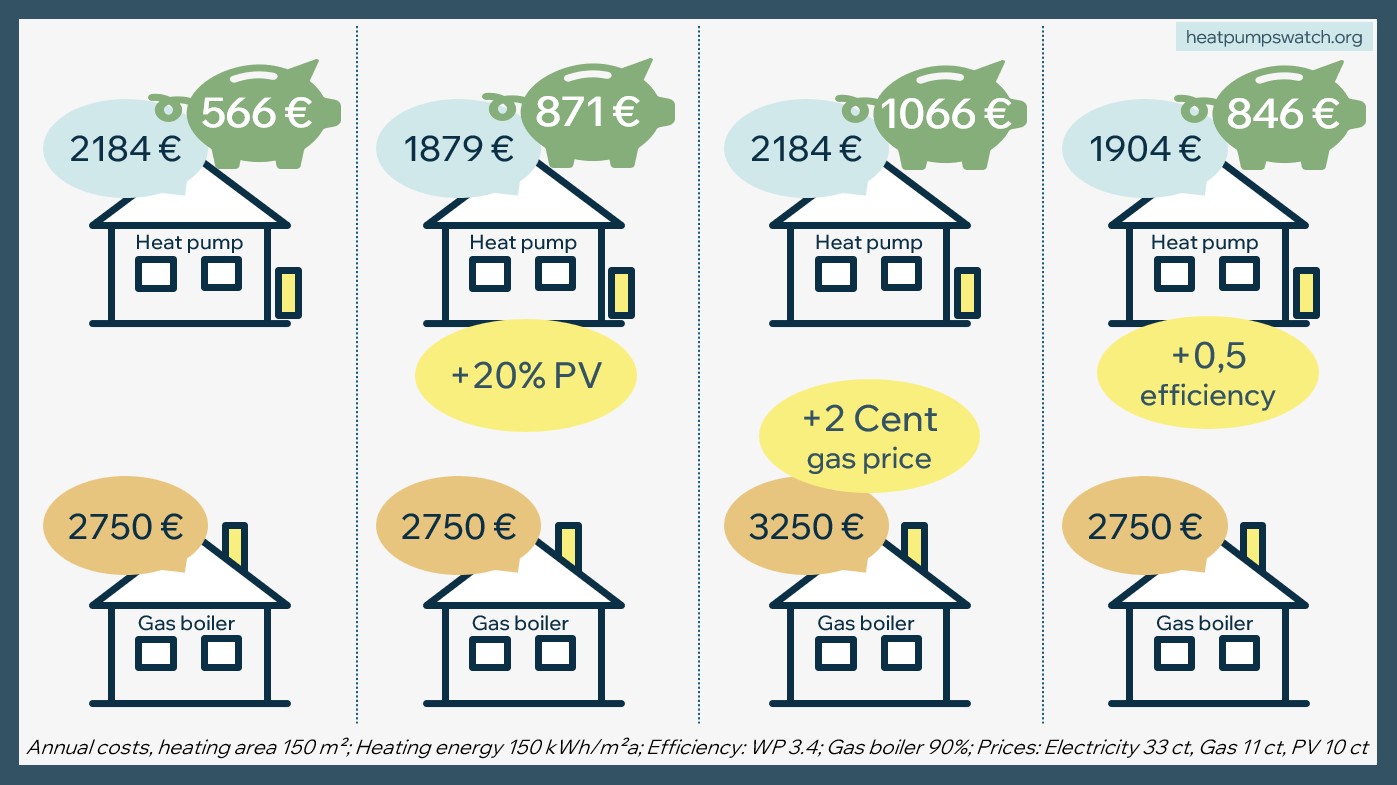
The heat pump must be economically viable – this is a central prerequisite for a successful heat transition. The available data shows that, given the current energy prices in Germany, the heat pump is already profitable today. With every year, the financial advantage over fossil heating systems is very likely to grow.
This article focuses on operating costs – i.e., the running costs for energy (excluding maintenance). The investment costs for purchase and installation will be covered in a future installment of this series. All calculations are based on prices and conditions in Germany. Since the ratio between electricity and gas prices is rather unfavorable for heat pumps here, the savings are significantly higher in many other European countries.
This article analyzes the various cost components of a heating system and how they can be influenced. The effects of various optimization measures are quantified using a concrete example. The long-term development of energy prices is considered on the basis of current scientific forecasts.
Factors influencing operating costs
The operating costs of a heating system can be divided into three categories, which differ in terms of how easily they can be influenced.
Fixed parameters
Some factors are determined by the characteristics of the building. The living space determines the total heat requirement. The location, with its specific climate, defines the heating degree days and thus the duration and intensity of the heating period. These parameters are fixed and only change in the long term.
Influential parameters
The energy standard of the building can be changed by measures taken on the building envelope. Insulating exterior walls, roofs, and basement ceilings, as well as replacing windows, can reduce the specific heating energy requirement. The possible reduction depends on the initial condition.
The efficiency of the heating system shows a fundamental difference between fossil fuel and electric systems. In the case of gas boilers, the efficiency of modern condensing boilers is around 90 percent. This value can hardly be increased further from a technical point of view. In the case of heat pumps, on the other hand, there is room for optimization by lowering the supply temperatures, adjusting the heating curve, hydraulic alignment, or switching to low-temperature heat emission systems. Field studies by Fraunhofer ISE show that these measures can increase the seasonal performance factor (SPF) of air/water heat pumps from an average of 3.0 to 3.5 or higher – an efficiency improvement of up to 17 percent.1
However, the savings achieved through increased efficiency are not linear. The greatest absolute savings are achieved with low initial efficiency values. An increase in the seasonal performance factor from 2.5 to 3.0 – i.e., by 0.5 points – reduces annual costs by €825 with an annual heat requirement of 22,500 kWh and an electricity price of 33 ct/kWh. The same increase of 0.5 points from an already good seasonal performance factor of 4.5 to 5.0 only results in savings of €275 per year – one third of the original savings. The reason lies in the mathematics: at low SPF values, electricity consumption is high, so any improvement in efficiency saves a lot of energy. At already high SPF values, electricity consumption is already low, so further improvements save less in absolute terms.
User behavior influences energy consumption through the selected room temperature, ventilation habits, and the use of heating controls. Lowering the room temperature by 1 Kelvin reduces heating energy requirements by about 6 percent. With an annual heating requirement of 22,500 kWh, this corresponds to a saving of 1,350 kWh. With a heat pump with a seasonal performance factor (SPF) of 3.4, this means 400 kWh less electricity consumption, which at 33 ct/kWh corresponds to an annual cost saving of 132 euros. With gas heating with 90 percent efficiency, this means 1,500 kWh less gas consumption, which at 11 ct/kWh corresponds to a saving of 165 euros.
Parameters with limited influence
Energy prices are the most important factor, but also the least controllable. There is a structural difference between fossil fuels and electricity in this regard. When it comes to natural gas, homeowners are exposed to global market prices and national policies, which are determined by geopolitical events, production volumes, and international trade relations. Switching suppliers can reduce costs moderately, but does not change the basic price level.
With electricity, on the other hand, there are options for influencing costs. A photovoltaic system can generate 20 to 30 percent of the heat pump’s electricity itself, at a production cost of 8 to 10 cents per kilowatt hour. Dynamic electricity tariffs allow consumers to take advantage of low exchange prices when there is a high level of wind or solar feed-in. Special heat pump tariffs are typically 3 to 5 cents below standard household electricity tariffs. These structural differences change the position of the consumer: while gas heating owners remain passive price takers, heat pump owners can become active price setters.2
Case study: Unrenovated single-family home
The following analysis is based on a typical unrenovated single-family home with 150 square meters of living space and a heating energy requirement of 150 kWh per square meter per year. This value is representative of existing buildings from the 1960s to 1980s without energy-efficient renovation. The website heatpumpswatch.org provides an interactive cost calculator that allows you to enter your own values and calculate your individual operating costs.
Initial data
The calculations use the following framework conditions. The electricity and gas prices quoted correspond to the average costs for existing customers in Germany at the end of 2025. New customers usually pay lower prices, which can be around 5 to 8 cents below these values.
| Parameter | Value |
| Heated Area | 150 m² |
| Heat Energy Consumption (Demand) | 150 kWh/m²a |
| Electricity Price (existing customer)3 | 33 ct/kWh |
| Gas Price (existing customer) | 11 ct/kWh |
| Seasonal Performance Factor (SPF) of the HP | 3,4 |
| Efficiency of the Gas Boiler | 90 % |
| PV Self-Consumption Share PV | 20 % |
| Feed-in Tariff PV | 10 ct/kWh |
The SPF value of 3.4 used corresponds to the current average value for newly installed air/water heat pumps in existing buildings according to field measurements by Fraunhofer ISE[1]. The feed-in tariff for PV systems varies depending on the time of installation. For newly installed systems, it is currently 8.6 ct/kWh, but may be higher for older systems. An average value of 10 ct/kWh is used in the calculation. Under these conditions, the following annual heating costs result:
| Heating System | Annual Costs |
| Gas Boiler | 2.750 € |
| Heat Pump | 2.184 € |
| Heat Pump with PV | 1.879 € |
| Difference HP – Gas | 566 € / year |
| Difference HP+PV – Gas | 871 € / year |
In an unrenovated building with an electricity-to-gas price ratio of 3:1, the annual cost savings of the heat pump compared to the gas boiler are €566. With a photovoltaic system, the difference increases to €1,030 per year.
Optimization scenarios
The initial situation already shows an economic advantage for the heat pump. The following scenarios quantify the effects of various optimization measures.
Increasing heat pump efficiency
The SPF can be increased through various measures. Lowering the flow temperatures is often the most effective single measure—a reduction of 5 Kelvin can increase the SPF by 0.3 to 0.5 points. Other measures include optimizing the heating curve, hydraulic balancing, switching to panel heating, and professional commissioning. Field studies show that many heat pumps are not operated optimally after installation (Fraunhofer ISE, 2025). The potential for optimization is considerable.
An increase in the SPF from 3.4 to 3.9 – an improvement that can be achieved through consistent optimization – reduces annual operating costs by a further €281. As already mentioned, the savings are greater at lower starting values. With an improvement from SPF 2.5 to 3.0, the annual savings would be almost three times as high at €825, while an increase from 4.5 to 5.0 would only save €275.
| SPF | Annual Costs HP | Difference to Gas |
| 3,4 (initial value) | 2.184 € | 566 € |
| 3,9 | 1.903 € | 847 € |
| Additional Savings: | 281 € | 281 € |
Variation of Gas Prices:
Gas prices are subject to significant fluctuations. An increase of one or two cents per kilowatt hour changes the economic efficiency:
| Gas Price | Annual Costs Gas | Difference to HP |
| 11 ct/kWh | 2.750 € | 566 € |
| 12 ct/kWh | 3.000 € | 816 € |
| 13 ct/kWh | 3.250 € | 1.066 € |
Every cent increase in gas prices increases the annual difference by €250. With an increase of two cents, the cost savings exceed €1,000 per year.
Energy-efficient renovation
Reducing energy consumption through renovation is the most effective measure for lowering heating costs. Two levels of renovation are considered: moderate renovation reduces heating energy consumption from 150 to 100 kWh/m²a, while comprehensive renovation reduces it to 50 kWh/m²a.
| Building (Renovation) State | Annual Costs HP | Annual Costs Gas |
| Non-renovated (150 kWh/m²a) | 2.184 € | 2.750 € |
| Moderately renovated (100 kWh/m²a) | 1.456 € | 1.833 € |
| Completely renovated (50 kWh/m²a) | 728 € | 917 € |
The combination of renovation and heat pump has the greatest effect: in a comprehensively renovated building, annual heating costs with a heat pump fall to less than €750 – less than a third of the original costs with gas heating in the unrenovated state.
Long-term development
The calculations to date are based on energy prices at the end of 2025. Future price developments are relevant for long-term investment decisions. Current scientific studies show consistent trends: electricity prices for households will fall, while gas prices will rise.
Several studies predict falling electricity prices. The Ariadne project of the Kopernikus consortium assumes a decline from the current 33-40 ct/kWh to 28-30 ct/kWh by 2030 and further to 25-27 ct/kWh by 2035.4 PROGNOS analyses commissioned by vbw show similar developments with electricity prices below 25 ct/kWh by 2045.5 The Friedrich-Alexander University of Erlangen-Nuremberg confirms this trend in its analysis of the German electricity market. The driving factors are the expansion of renewable energies with low marginal costs, falling grid fees due to increasing electrification, and government relief measures. Forecasts show a decline in grid fees from currently around 10 ct/kWh to around 6-7 ct/kWh by 2045.
Another factor that could contribute to falling electricity prices is the planned reduction of the electricity tax to the minimum permitted in the EU. Germany currently levies an electricity tax of 2.05 cents per kilowatt hour. However, the EU Energy Tax Directive allows a reduction to 0.05 cents per kilowatt hour. A complete reduction to the EU minimum would reduce electricity costs for households by around 2 cents per kilowatt hour. For a heat pump with an annual consumption of 6,600 kilowatt hours, this corresponds to additional annual savings of around 130 euros. This measure is being discussed politically and could further improve the economic efficiency of heat pumps.
The opposite trend is emerging for natural gas. Studies by Deloitte and the Öko-Institut predict a decline in natural gas demand in Germany of 33% by 2030, 67% by 2040, and 95% by 2050 compared to 2021.6 The KfW study on the establishment of heat pumps in Europe emphasizes the importance of the electricity-gas price ratio for the economic efficiency of heat pumps.7 While wholesale prices could remain stable, end customer prices are expected to rise from 11-12 ct/kWh (2025) to 12-13 ct/kWh (2030) and 14-15 ct/kWh (2035). The fixed costs of the gas network must be spread across an ever-decreasing number of customers. Network fees are expected to rise by around 30% by 2030. In addition, the CO₂ price is expected to rise from the current €55/t to €100-120/t by 2030 and could reach €150-215/t in the long term, which corresponds to a surcharge of 2-4 ct/kWh on the gas price.8
The fixed costs of the gas network must be spread across an ever-decreasing number of customers. Network fees are expected to rise by around 30% by 2030. In addition, the CO₂ price is expected to rise from the current €55/t to €100-120/t by 2030 and could reach €150-215/t in the long term, which corresponds to a surcharge of 2-4 ct/kWh on the gas price.
These price developments are changing the economic efficiency. The following scenarios arise for the example house with 150 m²: In 2030, with electricity prices at 28 ct/kWh, gas prices at 13 ct/kWh, and an improved seasonal performance factor (SPF) of 3.6, gas heating will cost €3,250 per year (an increase of €500 compared to 2025), while the heat pump will cost only €1,750 (€434 less than in 2025). The annual cost savings rise to €1,500 – three times as much as in 2025. This trend will continue to grow until 2035: with an electricity price of 25 ct/kWh, a gas price of 15 ct/kWh, and a seasonal performance factor of 3.8, gas heating will cost €3,750 per year, while a heat pump will cost €1,480. The difference of €2,270 per year is four times the current cost savings.
Conclusions
The analysis shows the economic superiority of heat pumps even under current conditions. The most important findings: Heat pumps save several hundred euros per year in unrenovated buildings with an unfavorable electricity-gas price ratio. With electricity, there are options for PV systems, flexible tariffs, and efficiency optimization that do not exist with gas. Electricity prices are falling in the long term, while gas prices are rising – a structural trend that has been ongoing for decades. Every year of waiting means lost savings of at least €3,000 to €7,500 over five years. The combination of energy-efficient renovation and heat pumps results in the lowest operating costs.
The fundamental difference between electricity and gas will increase: electricity costs are spread across more consumers due to electrification, while the shrinking number of gas users has to finance a largely constant infrastructure while CO₂ pricing rises.
Heat pumps are cost-effective and will become even more so. Every year with fossil fuel heating is a year of lost savings.
Operating cost calculator
You can reproduce all the calculations presented in this article using your own values. Our interactive cost calculator on our website is available for this purpose. The calculator allows you to run through various scenarios and determine the cost-effectiveness for your individual situation.
Click here to use the calculator
This article is part of our comprehensive series answering the 18 most important questions about heat pump technology. The series is organized into 6 thematic categories. Below you’ll find more articles from the same category, as well as the complete navigation to all other topics.
Economics & Costs
Operating expenses, installation costs, and long-term financial analysis. Real data on savings, price trends, and return on investment.

Episode 8: Operating Costs: Heat Pumps Already Outperform Gas Heating Systems Today
Save €400-1000/year compared to gas heating today – savings rise to €2,270/year by 2035. Interactive calculator included.

Episode 13: Heat Pump Installation Costs: Germany vs. Europe
German heat pump installations cost €20,000-40,000 – twice the European average. Analysis reveals why and what must change.
Foundations & Context
Why heat pumps matter for society, climate, and energy transition. Understand the big picture through social context, myth-busting, environmental impact analysis, and policy evaluation.
Episode 1: Beyond the Noise: What the Heat Pump Truly Means for Our Society
Why heat pumps are the fastest, most cost-effective path to energy independence – beyond political noise and fossil fuel myths.
Episode 4: The Heat Pumps Fact Check: Ten Myths Scientifically Disproven
Ten persistent myths scientifically debunked: heat pumps work in extreme cold, historic buildings, and with existing radiators.
Episode 17 (coming soon): Ecological viewpoint
Heat pumps reduce CO₂ emissions by 60-90% compared to gas heating. An environmental analysis.
Episode 18 (coming soon): Are Heat Pump Goals Achievable?
Achieving ambitious heat pump targets: Analysis of technical feasibility, economicviability, and political requirements for climate-neutral heating by 2045.
Technology & Systems
How heat pumps work, different system types, technological evolution, and refrigerant technology. From 20 years of progress to safety of natural refrigerants.
Episode 3: From Niche to Norm: 20 Years of Progress in Heat Pump Technology
Modern heat pumps: 10-15 dB quieter, 20% more efficient, and work up to 70°C—perfect for retrofits.
Episode 7: Hybrid Heat Pump Systems
Analysis reveals: Pure electric heat pumps outperform fossil hybrids in 95% of cases—lower costs, higher efficiency.
Episode 11: Between Air Conditioner and Heating System
Air-to-air heat pumps: lower installation costs, faster deployment, but different comfort level than water-based systems. Systemic comparison.
Episode 12: Heating Technologies Compared
Comprehensive comparison of all heating technologies: heat pumps, gas, hydrogen, biomass, and district heating – pragmatic decision framework.
Episode 16 (coming soon): Refrigerants
Refrigerant evolution: From R410A to natural refrigerants – environmental impact, safety, and efficiency of modern solutions.
Real-World Performace
Field studies, efficiency measurements, and proven results. 20 years of data from 840+ installations in all building types.
Episode 2: 20 Years of Field Studies Prove: Heat Pumps Efficient in Existing Buildings
20 years of field research monitoring 840+ heat pumps in existing buildings. Latest studies show average efficiency (SPF) of 3.4 – even with radiators.
Episode 5: Efficiency Knows no Age: Heat Pumps in Buildings from 1826 to Present Day
6 case studies from 1826-1995: Unrenovated historic buildings achieve SPF 3.5-5.1 with proper planning and hydraulics.
Episode 6: Heat Pumps in Multi-Family Buildings: The Key to Urban Decarbonization
100+ documented cases prove heat pumps work in apartment buildings worldwide – centralized systems to individual units.
Planning & Implementation
Selecting, installing, and optimizing heat pumps for your needs. Practical guides from system sizing to installer selection.
Episode 9: Thousands of Heat Pumps Models on the Market: How to Find the Right One for Me?
Navigate 10,000+ certified heat pump models: Step-by-step guide from heating load calculation to installer selection and system commissioning.
Smart Integration
AI optimization, solar integration, and intelligent energy management. Next-generation heating systems that learn, adapt, and maximize efficiency.
Episode 10: Heat Pumps and AI: A Perfect Match?
AI-controlled heat pumps boost efficiency by 5-13%, reduce costs 40%, and support grid flexibility—research proven.
Episode 14: HEMS: Intelligent Control for Heat Pump Systems
Smart home energy management systems optimize heat pump operation, reduce costs by 15-25%, and enable grid services.
Episode 15: Heat Pumps as Energy Systems
How, with the help of PV, battery storages and electric cars, heat pumps become efficient complete systems. Analysis on savings, own production and bidirectional charging
- D. Günther et al., „WP-QS im Bestand: Entwicklung optimierter Versorgungskonzepte und nachhaltiger Qualitätssicherungsmaßnahmen für Wärmepumpen im EFH-Bestand,“ Fraunhofer Institute for Solar Energy Systems ISE, Freiburg, Final Report, Oct. 2025. ↩︎
- ADAC (2025): Wärmepumpe: Kosten, Funktion & Förderung 2024/2025. Ratgeber Energie und Wohnen. ↩︎
- Verivox (2025): Vergleich Betriebskosten Wärmepumpe vs. Gasheizung. Marktanalyse Energiepreise Deutschland. ↩︎
- Gunnar Luderer (Hrsg.), Frederike Bartels (Hrsg.), Tom Brown (Hrsg.), Clara Aulich, Falk Benke, Tobias Fleiter, Fabio Frank, Helen Ganal, Julian Geis, Norman Gerhardt, Till Gnann, Alyssa Gunnemann, Robin Hasse, Andrea Herbst, Sebastian Herkel, Johanna Hoppe, Christoph Kost, Michael Krail, Michael Lindner, Marius Neuwirth, Hannah Nolte, Robert Pietzcker, Patrick Plötz, Matthias Rehfeldt, Felix Schreyer, Toni Seibold, Charlotte Senkpiel, Dominika Sörgel, Daniel Speth, Bjarne Steffen, Philipp C. Verpoort (2025): Die Energiewende kosteneffizient gestalten: Szenarien zur Klimaneutralität 2045. Kopernikus-Projekt Ariadne, Potsdam. https://doi.org/10.48485/pik.2025.003 ↩︎
- Prognos AG (2024): Strompreisprognose bis 2045. Study ordered by vbw – Vereinigung der Bayerischen Wirtschaft, Basel/Berlin. ↩︎
- Deloitte/Öko-Institut (2023): Natural gas demand outlook to 2050. ↩︎
- KfW Research (2025): Die Wärmepumpe etabliert sich in Europa – der Strompreis entscheidet. KfW Research Fokus Volkswirtschaft Nr. 487, Februar 2025. ↩︎
- Bundesregierung (2025): Abschaffung der Gasspeicherumlage ab 1. Januar 2026. ↩︎