

Hybrid Heat Pump Systems
The heating transition (Wärmewende) requires a complete shift away from fossil fuels—from an economic, security policy, and ecological perspective. In the public debate, however, so-called hybrid systems are repeatedly presented as a supposedly pragmatic solution. But what is behind this technology? And for whom might it actually be sensible?
The analysis of scientific research results shows an unambiguous outcome: Hybrid systems are only rarely a sensible choice and pose long-term risks for households and climate protection.
What is a Hybrid System?
A heating system that provides heat exclusively via the heat pump is called monovalent. If the heat pump is merely supplemented by an electric heating element (same energy carrier), this is referred to as a monenergetic system.
When another heat generator – for example, a gas or oil boiler – provides heating alongside the heat pump, this is called a bivalent system. A heat pump hybrid system is typically understood as a system in which these two heat generators with different energy carriers (e.g., electricity and gas) are combined and have common control.
According to the EU Ecodesign Regulation1, a hybrid heat pump is a combination unit that combines a space heating device with a heat pump with an auxiliary heating device, typically based on fossil fuels or biomass. Both components work together to ensure space heating (and possibly domestic hot water preparation).
Various configurations are available on the market: both systems where the heat pump is in the foreground and is only supplemented with a small peak boiler, as well as devices that primarily consist of a gas or oil boiler and are merely extended with a small heat pump.
Why Are Hybrid Systems Considered?
Several arguments are put forward in favor of hybrid systems. However, critical analysis shows that these arguments rarely hold up under closer scrutiny.
Argument 1: High Heating Energy Demand
A frequently cited reason is a very high heating energy demand of the house and the resulting performance requirements for the heat pump. If the heat pump were unable to supply the necessary heat in all cases, it would need to be supported by an additional heat generator.
Fact check: For single and two-family homes, this case is very unlikely. Results from Fraunhofer ISE monitoring projects in existing buildings clearly show that heat pumps are capable of delivering the necessary heat even during very cold periods – either alone or with minimal support from an electric heating element. In the field installations studied, the average heating element share of total electricity consumption was less than 2 percent.2
Argument 2: Environmental Optimization
With falling outdoor temperatures, the heat pump’s efficiency also decreases. Below a certain efficiency level and with an electricity mix dominated by fossil fuels, it could – according to the argument – be more environmentally friendly to heat with a gas boiler rather than the heat pump.
Fact check: This argument is based on outdated assumptions. The German electricity mix achieved a record share of renewable energy of around 60 percent in 2024. On average, only 363 grams of CO2 were emitted per kilowatt-hour.3 Studies show that heat pumps reduce CO2 emissions by an average of 64 percent compared to gas heating.4 Studies demonstrate: only in extremely fossil-heavy electricity grids could hybrid heat pumps potentially outperform “standalone” heat pumps in emissions – however, Europe’s electricity grids are rapidly becoming greener. Put differently: in Germany, an average heat pump would have efficiency even at -15°C that allows it to operate more environmentally friendly than a gas boiler.
Argument 3: Operating Cost Savings
The outdoor temperature-dependent efficiency of the heat pump affects momentary operating costs. Below a certain outdoor temperature, efficiency could be so low that temporary use of a gas boiler would be worthwhile.
Fact check: With current electricity and gas prices in Germany5 (with a ratio of 2.8), the dynamic economic threshold temperature is approximately -2 degrees Celsius. With the already legally planned CO2 pricing, this threshold shifts further into the negative range. With an assumed CO2 tax of 100 euros per ton, the threshold temperature is -11 degrees Celsius – then the heat pump practically takes over 99% of heat provision.6
Analysis by Building Type
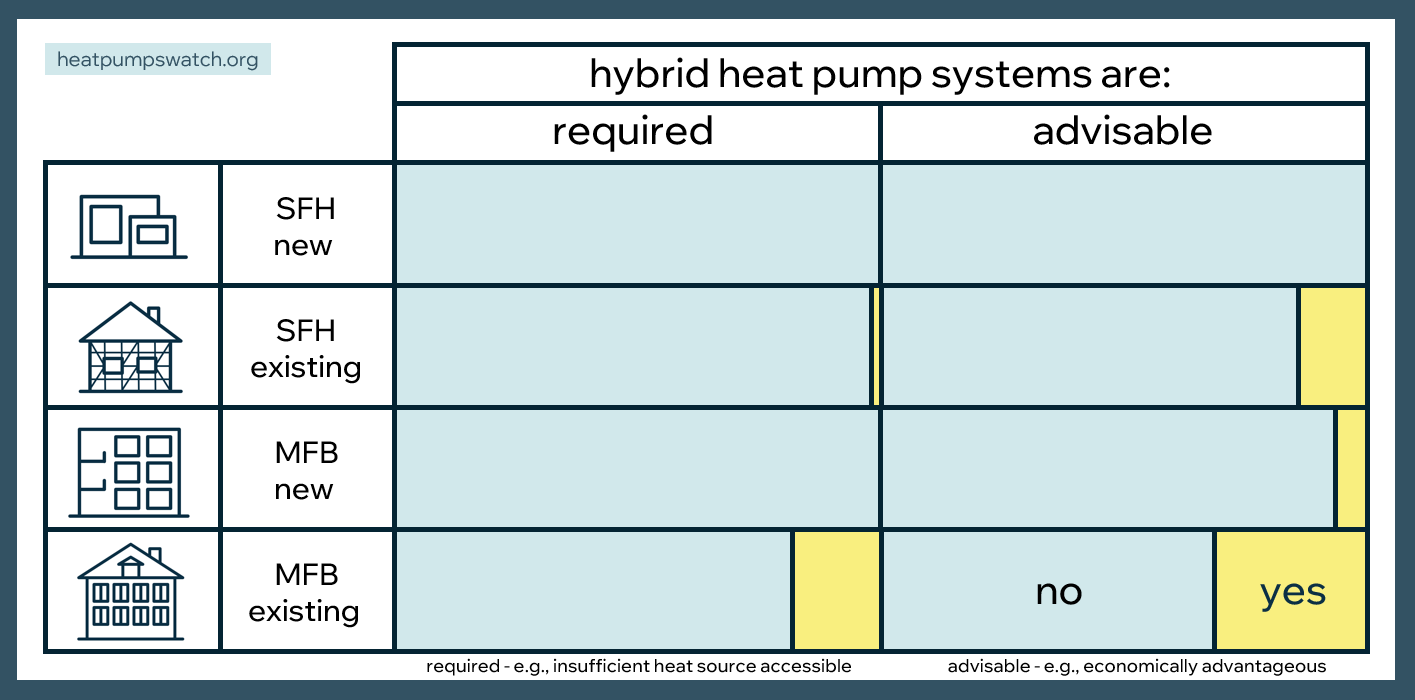
The sensibility of hybrid systems must be considered differentiated by building type. This shows: in the vast majority of cases, a monovalent or monenergetic heat pump solution is the better choice.
Single-Family Homes – New Construction
Recommendation: Hybrid System Not Sensible
New buildings are constructed according to current energy standards and have very good thermal insulation. The heating demand is correspondingly low. Modern heat pumps can easily cover the entire demand – even on the coldest days of the year. A hybrid system would cause unnecessary investment costs here. There is no need for fossil backup heating in new buildings.
Single-Family Homes – Existing Buildings
Recommendation: Hybrid System Only in Exceptional Cases
Field studies from the last 20 years in Europe clearly show: heat pumps work very well in existing buildings too. The studied monenergetic heat pump systems were able to provide the necessary performance even for houses with very high heating energy demand.
In very rare cases – for example, in extremely poorly insulated buildings with very high flow temperatures above 65 degrees and without possibility to optimize the heat distribution system – a hybrid solution could be considered as a temporary transitional solution. However, this should always be connected with a clear plan for complete decarbonization. Simple and cost-effective renovation measures or the replacement of individual radiators is sufficient in most cases for good heat pump operation, and consequently the hybrid solution can be dispensed with.
Multi-Family Buildings – New Construction
Recommendation: Hybrid System Not Sensible
In new construction of multi-family buildings, fossil hybrid systems are unnecessary in most cases and a missed opportunity to use the full freedom of planning. The greatest advantage in new construction is that ideal structural conditions can be created from the outset, leading to minimal heating loads and low flow temperatures. The pure heat pump can guarantee heat supply alone under these conditions. The decision for a fossil hybrid system means an unnecessary additional expense in this ideal environment, as dual infrastructure is required: that for the heat pump and additionally the gas connection with exhaust system for the boiler. This increases initial construction costs, occupies valuable space in the technical room, and creates no measurable efficiency advantage. On the contrary, it binds the building long-term to a fossil fuel whose prices and grid charges will rise in the coming decades, although a fully electric solution could avoid this dependency.
Multi-Family Buildings – Existing Buildings
Recommendation: Hybrid System Only with Technical Restrictions
In the renovation of existing multi-family buildings, specific technical challenges can arise that make a pure heat pump solution difficult. Unlike new construction, there is no complete freedom in system choice here. Obstacles are often the limited areas for accessing heat sources (e.g., ground probes), the higher necessary flow temperatures in uninsulated existing buildings, and the complex hydraulic conditions. The Fraunhofer LowEx-Bestand project has analyzed these requirements in detail.7 In such cases, where the heat source cannot be sufficiently accessed or space for an adequately dimensioned pure heat pump is lacking, a hybrid solution can be considered as a transition. The fossil component then serves to close the remaining gap for peak load coverage, while the heat pump provides the energy-efficient base load.
Domestic Hot Water Challenge in Multi-Family Buildings
A frequently cited argument for hybrid systems in multi-family buildings is domestic hot water (DHW) preparation. Legal requirements for Legionella prevention (DIN 1988-200, DVGW W 551) require 60°C at the storage tank and at least 55°C in the pipes. These temperatures can be challenging for heat pumps in large buildings with associated very long pipes. Therefore, fossil backup boilers are often used in this case. However, there are also proven technical solutions here.
Decentralized Apartment Stations (Fresh Water Stations)
With this solution, drinking water is heated using the flow-through principle. Since the downstream volume is below 3 liters, the strict temperature requirements are eliminated. The heat pump must deliver significantly lower temperatures, which increases efficiency. This technology is already standard in new buildings and can also be retrofitted in existing buildings.
Central-Decentralized Systems
In this case, a central heat pump is used to provide the base load in a thermal network at a lower temperature level, and additionally smaller decentralized heat pumps (booster heat pumps) are used in each apartment. This solution makes it possible to provide both heating and DHW preparation efficiently and without large pipe losses.
Thermal Disinfection with Heating Element
Another option is the combination of the heat pump with an electric heating element. The heat pump delivers the base load, while the heating element is only used for periodic thermal disinfection (above 60°C). This increases electricity consumption, but at the same time completely avoids the use of fossil fuels.
Ultrafiltration Systems
For central storage systems operated at lower temperatures, hygienic operation can be ensured through the use of ultrafiltration systems (UF systems). These effectively filter germs and microorganisms like Legionella from the water, enable lower storage temperatures, and thus contribute to increasing the heat pump’s efficiency. However, the use of UF systems is still in the investigation phase and is currently not clearly approved for achieving the required hygiene standard.
Problems and Risks of Hybrid Systems
Field studies (e.g., by Fraunhofer ISE) show that the complexity of fossil hybrid systems can lead to problems in practice.
Control problems: The complicated control of the system is prone to errors. In many cases, it has been documented that the fossil boiler (gas/oil) unnecessarily intervenes often and for long periods due to premature comfort criteria or programming errors, which undesirably increases the fossil coverage share.
Hydraulic inefficiency: The integration of two heat generators leads to complex hydraulics that can cause flow errors in the heating circuit. This causes energy losses, as unnecessarily high temperatures are maintained.
Bad investment through oversizing: Systems have been documented in which the fossil boiler practically never or only marginally ran after commissioning. In such cases, a sufficiently dimensioned heat pump could have ensured heat supply alone – the hybrid component was a superfluous investment.
The complexity of the hybrid solution is thus the greatest risk factor, as it leads either to higher emissions or to unnecessary investments.
Sensible “Hybrids”: Heat Pump + Renewables
In this article, a hybrid system is primarily understood as the critical combination of heat pump and fossil boiler. In contrast, there are sensible hybrid configurations that couple the heat pump with other renewable energy sources, such as solar thermal or photovoltaics (PV). Such combinations, possibly supplemented by battery storage, can significantly increase the heat pump’s efficiency and the building’s degree of self-sufficiency without resorting to fossil fuels.
Excursus: The Netherlands – A Special Situation
The widespread adoption of hybrid heat pumps in the Netherlands is less proof of the universal superiority of the technology than the result of specific technical and political framework conditions that are only conditionally transferable.
A decisive technical success factor is the availability of highly compact and economically attractive add-on hybrid systems. With acquisition costs in the low four-digit range before subsidies – significantly below the costs of complete heat pump systems in Germany – and simple installation through direct connection to the existing high-efficiency gas boiler in just 1-2 days, the entry barrier is minimal. The compact indoor unit fits next to practically any existing gas boiler. Government subsidies of 20-30% of investment costs further improve the economics. With an average gas saving of 60-75%, an attractive cost-benefit ratio emerges for existing buildings. The use of exhaust air heat from widespread mechanical ventilation systems, which was important in the early phase of market introduction, now plays hardly any role in current add-on systems.
Politically, the hybrid system was positioned as a pragmatic, quickly implementable, and financially viable transitional step for existing buildings to rapidly reduce high gas consumption. However, the fundamental dependence on fossil gas infrastructure remains – with the associated long-term risks of rising grid charges and delayed complete decarbonization. The regulation clearly emphasizes this differentiated strategy: while the hybrid solution is to become the minimum standard for boiler replacement in existing buildings from 2026, new buildings must already be heated entirely electrically from 2025. The ambitious goal of 2 million hybrid systems by 2030 demonstrates a deliberate decision for gradual transformation through cost-effective intermediate solutions. This strategy avoids the often falsely portrayed necessity of comprehensive full renovation. At the same time, it foregoes complete decarbonization, which would already be possible today with monoergetic heat pumps even in moderately renovated existing buildings.
Lock-in Effect and Insufficient Decarbonization
Hybrid systems can become a long-term technology trap that delays or prevents complete decarbonization. Concrete risks are:
- Many countries plan to significantly reduce gas consumption in the building sector by 2040. It is questionable whether hybrid systems installed in large numbers by then will be replaced in time.
- With the progressive electrification of heat supply, the remaining gas customers will have to distribute the costs of gas infrastructure among fewer shoulders. Grid charges per cubic meter of gas will rise – and the more so, the fewer customers remain on the grid. Households with hybrid systems that continue to use gas will have to bear these rising costs.
- The installation of a fossil hybrid system offers the convenient possibility of postponing the necessary energy renovation of the building envelope. As a result, the total heat demand remains unnecessarily high. Instead of reducing heat demand (renovation), investment is made in compensation through hybrid technology, which delays the path to climate neutrality.
Recommendations for Homeowners and Policy
For homeowners: In the vast majority of cases, a pure heat pump solution (monovalent or monenergetic) is the technically, ecologically, and long-term economically most sensible option. The technology is mature, its efficiency in existing buildings is proven many times over, and it avoids future dependencies on fossil price and infrastructure developments.
Hybrid solutions with a fossil component should be limited to clearly defined exceptional cases – for example, with specific technical restrictions in large existing multi-family buildings where heat sources can only be accessed to a limited extent or where converting DHW preparation is currently associated with disproportionately high costs. Even then, a binding transformation path toward a completely renewable solution is crucial.
For policymakers, this means: when energy systems are aligned with climate neutrality, new lock-in effects into fossil infrastructure should be avoided. Under European climate conditions, possible advantages of fossil-operated hybrid systems are limited and uncertain, while the associated risks – for households as well as for the energy system – can be considerable.8
Conclusion
Hybrid heat pump systems with fossil backup generation are only sensible in a few, narrowly defined exceptional cases. The often-cited advantages relativize themselves upon closer analysis or prove to be outdated. Short-term flexibility gains are dearly paid for in the long term through higher investment and operating costs, additional system complexity, and delayed decarbonization. Wherever technically possible, fully electric heat pump systems oriented toward renewable sources should therefore form the standard.
This article is part of our comprehensive series answering the 18 most important questions about heat pump technology. The series is organized into 6 thematic categories. Below you’ll find more articles from the same category, as well as the complete navigation to all other topics.
Technology & Systems
How heat pumps work, different system types, technological evolution, and refrigerant technology. From 20 years of progress to safety of natural refrigerants.

Episode 3: From Niche to Norm: 20 Years of Progress in Heat Pump Technology
Modern heat pumps: 10-15 dB quieter, 20% more efficient, and work up to 70°C—perfect for retrofits.

Episode 7: Hybrid Heat Pump Systems
Analysis reveals: Pure electric heat pumps outperform fossil hybrids in 95% of cases—lower costs, higher efficiency.

Episode 11: Between Air Conditioner and Heating System
Air-to-air heat pumps: lower installation costs, faster deployment, but different comfort level than water-based systems. Systemic comparison.

Episode 12: Heating Technologies Compared
Comprehensive comparison of all heating technologies: heat pumps, gas, hydrogen, biomass, and district heating – pragmatic decision framework.

Episode 16 (coming soon): Refrigerants
Refrigerant evolution: From R410A to natural refrigerants – environmental impact,
safety, and efficiency of modern solutions.
Foundations & Context
Why heat pumps matter for society, climate, and energy transition. Understand the big picture through social context, myth-busting, environmental impact analysis, and policy evaluation.
Episode 1: Beyond the Noise: What the Heat Pump Truly Means for Our Society
Why heat pumps are the fastest, most cost-effective path to energy independence – beyond political noise and fossil fuel myths.
Episode 4: The Heat Pumps Fact Check: Ten Myths Scientifically Disproven
Ten persistent myths scientifically debunked: heat pumps work in extreme cold, historic buildings, and with existing radiators.
Episode 17 (coming soon): Ecological viewpoint
Heat pumps reduce CO₂ emissions by 60-90% compared to gas heating. An environmental analysis.
Episode 18 (coming soon): Are Heat Pump Goals Achievable?
Achieving ambitious heat pump targets: Analysis of technical feasibility, economicviability, and political requirements for climate-neutral heating by 2045.
Economics & Costs
Operating expenses, installation costs, and long-term financial analysis. Real data on savings, price trends, and return on investment.
Episode 8: Operating Costs: Heat Pumps Already Outperform Gas Heating Systems Today
Save €400-1000/year compared to gas heating today – savings rise to €2,270/year by 2035. Interactive calculator included.
Episode 13: Heat Pump Installation Costs: Germany vs. Europe
German heat pump installations cost €20,000-40,000 – twice the European average. Analysis reveals why and what must change.
Real-World Performace
Field studies, efficiency measurements, and proven results. 20 years of data from 840+ installations in all building types.
Episode 2: 20 Years of Field Studies Prove: Heat Pumps Efficient in Existing Buildings
20 years of field research monitoring 840+ heat pumps in existing buildings. Latest studies show average efficiency (SPF) of 3.4 – even with radiators.
Episode 5: Efficiency Knows no Age: Heat Pumps in Buildings from 1826 to Present Day
6 case studies from 1826-1995: Unrenovated historic buildings achieve SPF 3.5-5.1 with proper planning and hydraulics.
Episode 6: Heat Pumps in Multi-Family Buildings: The Key to Urban Decarbonization
100+ documented cases prove heat pumps work in apartment buildings worldwide – centralized systems to individual units.
Planning & Implementation
Selecting, installing, and optimizing heat pumps for your needs. Practical guides from system sizing to installer selection.
Episode 9: Thousands of Heat Pumps Models on the Market: How to Find the Right One for Me?
Navigate 10,000+ certified heat pump models: Step-by-step guide from heating load calculation to installer selection and system commissioning.
Smart Integration
AI optimization, solar integration, and intelligent energy management. Next-generation heating systems that learn, adapt, and maximize efficiency.
Episode 10: Heat Pumps and AI: A Perfect Match?
AI-controlled heat pumps boost efficiency by 5-13%, reduce costs 40%, and support grid flexibility—research proven.
Episode 14: HEMS: Intelligent Control for Heat Pump Systems
Smart home energy management systems optimize heat pump operation, reduce costs by 15-25%, and enable grid services..
Episode 15: Heat Pumps as Energy Systems
How, with the help of PV, battery storages and electric cars, heat pumps become efficient complete systems. Analysis on savings, own production and bidirectional charging
- Verordnung (EU) Nr. 813/2013 der Kommission vom 2. August 2013 zur Durchführung der Richtlinie 2009/125/EG des Europäischen Parlaments und des Rates im Hinblick auf die Festlegung von Anforderungen an die umweltgerechte Gestaltung von Raumheizgeräten und Kombiheizgeräten. Amtsblatt der Europäischen Union, L 239, 6. September 2013, S. 136–162. ↩︎
- Heatpumpswatch.org. (2025). 20 Jahre Feldstudien: Wärmepumpen effizient im Altbau. Abruf am 25.11.25 unter https://heatpumpswatch.org/de/20-jahre-feldstudien-waermepumpen-effizient-im-altbau/ ↩︎
- Umweltbundesamt (UBA): Entwicklung der spezifischen Treibhausgas-Emissionen des deutschen Strommix in den Jahren 1990 – 2024. Climate Change 13/2025. Dessau-Roßlau, 2025. ↩︎
- D. Günther et al., „WP-QS im Bestand: Entwicklung optimierter Versorgungskonzepte und nachhaltiger Qualitätssicherungsmaßnahmen für Wärmepumpen im EFH-Bestand,” Fraunhofer-Institut für Solare Energiesysteme ISE, Freiburg, Abschlussbericht, Okt. 2025. ↩︎ ↩︎
- Stand 7.12.2025, Quelle ZEIT-Online Energiemonitor ↩︎
- Öko-Institut und Fraunhofer ISE (2022): Durchbruch für die Wärmepumpe. Praxisoptionen für eine effiziente Wärmewende im Gebäudebestand. Studie im Auftrag von Agora Energiewende ↩︎
- Neubert, D.; Glück, C.; Wapler, J.; Marko, A.; Bongs, C.; Felsmann, C. Field Trial Evaluation of a Hybrid Heat Pump in an Existing Multi-Family House before and after Renovation. Energies 2024, 17, 1502. https://doi.org/10.3390/en17061502 ↩︎
- Gibb, D. & Lowes, R. (2024, October). One foot in the past: The role of hybrid heat pumps in Europe. Regulatory Assistance Project. ↩︎