

HEMS: Intelligent Control for Heat Pump Systems
The energy system of the future is becoming increasingly electrified. Heat pumps are replacing gas heating systems, electric cars are displacing combustion engines, and photovoltaic systems on millions of roofs are turning households into small power generators. This development is a climate policy necessity and follows a technical logic at the same time: electricity from renewable sources can be generated, stored, and distributed more efficiently than fossil fuels. And because everything operates with the same energy carrier, new networking possibilities arise.
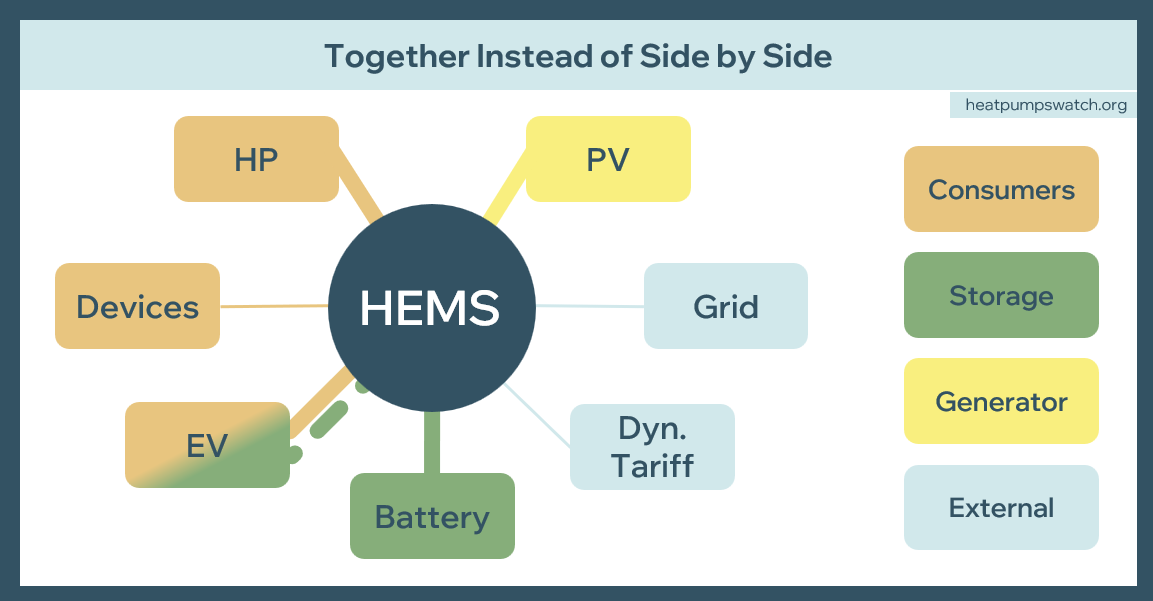
However, this networking also makes the system more complex. In a household with a heat pump, PV system, battery storage, and wallbox, several generators and consumers interact—all responding to different signals. Without intelligent coordination, these devices work alongside each other instead of with each other. Increasing digitalization is not only helpful here, but necessary. At the level of the individual residential building, so-called home energy management systems—HEMS for short—are used for this purpose.
This article explains what a HEMS is, what variants exist, and why it is becoming increasingly relevant for households with heat pumps. The following episode 15 then shows how the heat pump interacts with PV, storage, and dynamic tariffs in practice.
What is a Home Energy Management System?
Essentially, a HEMS involves connecting and coordinating the various energy sources and consumers in the household. The heat pump plays a central role here: it is often the largest controllable electricity consumer in the home and, at the same time, the one that can respond most flexibly to different operating modes. A modern HEMS records in real time how much electricity is generated, consumed, and stored, takes into account external information such as electricity prices or weather forecasts, and makes automated decisions based on this information.1,2
It is important to note that HEMS is not a standardized product. The spectrum ranges from simple monitoring solutions that merely visualize energy flows to highly integrated systems that actively control heat pumps, wall boxes, and storage units while responding to electricity exchange prices or grid signals. Anyone interested in a HEMS should therefore carefully check which functions a particular system actually offers.
In the fully developed version, four functional levels can be distinguished:
- Monitoring – the real-time recording of all energy flows,
- Active control of consuming components, in particular the heat pump,
- Optimization using algorithms that take weather forecasts, electricity prices, and usage behavior into account, and
- Communication with the power grid, the energy supplier, and the user.3
Distinction from Related Terms
Related terms are often confused in discussions. A smart home primarily focuses on comfort—lighting, shutters, entertainment electronics. A HEMS can be part of a smart home system, but focuses exclusively on energy optimization. The SG-Ready interface, which many heat pump owners are familiar with, is not a standalone management system, but a simple communication standard with four operating states. A HEMS goes far beyond this by not only sending simple commands, but also optimizing based on extensive data.1
Which Variants are Available on the Market?
The market offers a diverse landscape. The HEMS sector is characterized by a multitude of different providers and product philosophies. Energy management can be conceived as a hardware product, a software solution, a service, or part of a larger ecosystem. For heat pump owners, this raises the question: Which system is right for their situation?
The HEMS Market Overview 2025, compiled by researchers at Ansbach University of Applied Sciences and the Technical University of Munich, documents 43 systems from 41 providers on the German market.4 Other overviews, such as that published by pv magazine, also confirm the wide variety of solutions available.5 These differ primarily in three dimensions: technical architecture, business model, and degree of manufacturer independence.
System Design
The technical implementation has a direct impact on how quickly a system can respond and how independently it functions from the internet. Just under half of the systems are standalone hardware controllers that are installed in the building and operate as dedicated control units. These process data locally and can maintain basic functions even in the event of an internet failure. In addition, there are systems that are embedded in existing hardware—for example, integrated into a battery storage unit—as well as pure cloud solutions without their own device in the household.4
For heat pump owners, it is particularly relevant whether the HEMS is manufacturer-specific or manufacturer-independent. The market overview paints a positive picture: around 96 percent of the systems examined can integrate heat pumps from different manufacturers.1 In practice, however, actual compatibility depends on the specific heat pump and the available interface.
Communication between HEMS and Heat Pump
In order for a HEMS to control a heat pump, both devices must communicate with each other. This sounds obvious, but in practice it is one of the biggest stumbling blocks – because there is no uniform standard. The most common variant currently is the SG-Ready interface, which signals four operating states via simple contacts. However, this is not sufficient for truly intelligent control, because more differentiated specifications – such as a specific flow temperature or gradual power adjustment – cannot be transmitted with it.
EEBus, a communication protocol developed specifically for interaction between energy devices in the home, is considered to be forward-looking and is also expected to play a central role in new legal requirements. However, the 2025 market overview shows that around a quarter of HEMS providers are only planning to implement such integrations.4 For heat pump owners, this means that before purchasing, they should check whether their own heat pump can actually communicate with the desired system – and to what extent.
Business Models
The vast majority of HEMS systems are not sold directly to end customers, but are distributed through specialist companies, specialized solar installers, or energy suppliers. Distribution through commercial partners clearly dominates.4 This can be advantageous for end customers if the local energy supplier puts together an integrated package of electricity tariffs and energy management. However, it also means that the choice of HEMS is often linked to the choice of installer or energy supplier.
In recent years, some providers have positioned themselves as full-service providers. Companies such as Enpal, 1Komma5°, and Thermondo offer not only heat pumps but also photovoltaics, storage, and an integrated energy management system. These all-in-one solutions promise seamless integration of all components and central control from a single source. This can be attractive for households that are already planning a comprehensive energy-efficient renovation. However, it remains to be seen how flexible such closed systems will be when it comes to later expansions or the replacement of individual components.
Why HEMS is Now Becoming More Significant
Energy management systems are not an entirely new idea—simple controls for optimizing self-consumption have been around since the rise of photovoltaics. The fact that HEMS is becoming a widely discussed topic right now is due to a combination of several developments. For heat pump owners, four drivers are particularly relevant.
New Legal Requirements
Since January 2024, Section 14a of the Energy Industry Act stipulates that controllable consumption devices – primarily heat pumps and wall boxes – must be integrated in a way that benefits the grid. In concrete terms, this means that the grid operator may temporarily reduce the output of these devices in the event of bottlenecks. In return, there are discounts on grid fees.6 The technical recommendations for implementing this grid-oriented control have been specified by VDE FNN.7 A HEMS can intelligently distribute this reduction among the various consumers and offset it against PV generation, so that the restriction is hardly noticeable in everyday life.
Dynamic Electricity Tariffs are Becoming Economically Viable
For a long time, electricity prices for residential customers were static – regardless of whether it was nighttime, midday, or early evening. That is currently undergoing a fundamental change. More and more providers are introducing dynamic tariffs, with prices based on the hourly rate on the electricity exchange. A recent study estimates the average savings potential for households with intelligent load management at around 15 percent of electricity costs.8 For a household with a heat pump and normal consumption, this can amount to several hundred euros per year. A HEMS can automatically run the heat pump when electricity is cheap and pause it during expensive hours – without compromising thermal comfort.
System Use for the Common Power Grid
While the points mentioned so far primarily concern individual households, there is also a macroeconomic perspective. If millions of heat pumps, electric cars, and battery storage systems can be shifted in time, this will significantly stabilize the entire power grid. A study by Roland Berger and the New Energy Alliance estimates the potential macroeconomic savings from decentralized flexibility at €185 to €255 billion by 2045 – primarily through savings in investments in grids and power plants.9 These savings potentials are also confirmed by international studies, which show considerable economic benefits for the EU by 2030 through demand-side flexibility.10 Investments of several hundred billion euros are forecast for the expansion of the electricity grids in Germany alone by 204511 – some of which could be avoided through intelligent decentralized control. A comprehensive study by Agora Energiewende on the use of household-related flexibilities shows that heat pumps, electric cars, and battery storage play a central role in this.12 For individual heat pump owners, this system benefit is abstract at first, but could become visible in the future in the form of remuneration or further discounts.
Increasing Self-Use with PV-Systems
For households with heat pumps and photovoltaic systems, self-consumption is a key factor. Every kilowatt hour generated in-house and consumed directly in the home saves on expensive grid electricity and brings significantly more value than the low feed-in tariff. The trend is clearly upward: current analyses by Fraunhofer ISE show that self-consumption of solar power in Germany has risen sharply in recent years.13 A HEMS can activate the heat pump specifically when the sun is shining – for example, by proactively heating the buffer storage tank in the morning. Field measurements by Fraunhofer ISE on an existing building with a PV battery heat pump system showed that intelligent control both improved the efficiency of the heat pump and significantly increased solar self-consumption.14 In its annual electricity storage inspection, HTW Berlin also showed that the efficiency of battery storage systems—an important component for high self-consumption—has risen continuously in recent years.15
Limits and the Challenges
Despite its potential, HEMS is not a sure-fire success. There are several hurdles that currently limit its practical use.
Cost-effectiveness Depends on the Situation
There is no blanket answer to the question of whether HEMS is worthwhile for a specific household. It depends on several factors: the size of the PV system, the availability of battery storage, the type of electricity tariff, the complexity of the consumers, and, last but not least, the cost of the system itself. The investment costs vary considerably depending on the range of functions: simple software solutions are available from around 300 euros, while hardware-based systems typically cost between 700 and 1,200 euros. According to the Consumer Advice Center, a fully integrated system incorporating a PV system, storage, heat pump, and wallbox can quickly cost over 1,000 euros.16 Installation costs and ongoing fees for cloud services may also apply.
In households that already operate a heat pump, PV system, and electric car, a HEMS can often pay for itself within a few years—especially if a dynamic electricity tariff is used. In simpler configurations—such as only a heat pump and a small PV system without any other consumers—the calculation is less clear-cut. In such cases, the payback period can be significantly longer. It is therefore crucial to make a realistic assessment of your own initial situation.
Lack of Standardization and Compatibility
One of the biggest practical problems is the lack of interoperability. Not every HEMS can communicate with every heat pump, not every storage unit with every inverter, and not every wallbox with every electricity meter. Although various initiatives are working on uniform standards, in practice the system landscape is still highly fragmented. For installers, this often means time-consuming individual case checks, and for homeowners, it means limited flexibility for later expansions.
Another problem is that the vast majority of HEMS systems require a smart meter. This meter records electricity consumption at high temporal resolution, which is what enables precise control in the first place. However, the mandatory rollout of smart metering systems is progressing slowly in Germany. By the end of 2024, only around 3.8 percent of households were equipped with a smart meter.17 Without this meter, the functionality of many HEMS systems remains significantly limited.
Consulting and Installation
One aspect that is often underestimated is the quality of consulting. Determining which HEMS is suitable for which household requires experience and an overview of different systems. However, many installers specialize in one or two systems and are unable to offer impartial advice. A survey of installers also shows that many specialist companies are still uncertain about how to deal with HEMS and dynamic tariffs. In addition, there is often a lack of skilled workers who are proficient in heating technology as well as electrical engineering and network technology. Since March 2024, there has been a corresponding qualification in the form of the newly structured master electrician with a focus on building system integration, but the number of trained specialists is still low.18
How will the Market Develop?
The coming years will show whether HEMS becomes a default component in households with heat pumps or whether it remains – for now – a solution for especially interested building owners.
Regulatory Changes
A key milestone is what is known as energy sharing, which has been enshrined in law since December 2025. This allows homeowners to sell surplus solar power directly to their neighbors for the first time – a fundamental extension of the previous logic, whereby electricity could only be fed into the public grid.19 This new option makes HEMS more interesting for single-family homes in neighborhood associations as well as for multi-family homes and neighborhood concepts, as coordination between several households opens up new optimization potential.
Standardization and Interoperability
The biggest technical challenge remains the lack of standardization. Various initiatives are working to ensure that devices from different manufacturers can work together smoothly in the future. An important step in this direction was the adoption of specifications for HEMS by the Working Group for Economical Energy and Water Use, which provides municipal utilities with guidance for tendering systems.20 Standards are also being advanced at the European level.21 A concrete example is the Code of Conduct for Energy Smart Appliances, developed by the European Commission together with manufacturers – including heat pump manufacturers – and officially launched in April 2024. The initiative aims to promote cross-brand interoperability of smart devices on a voluntary basis, by defining common communication standards for demand flexibility services. From March 2026, compliant products will be searchable in the European EPREL database. However, it will still take time before these initiatives take full effect across the market.22
Market Availability and Distribution
With over 40 systems available in Germany alone, the selection is already considerable. However, market penetration remains low: a survey of 300 end users in Germany, the UK, and the Netherlands revealed that although half of those surveyed would be interested in flexibility programs, only ten percent currently participate in them.23 The gap between interest and actual adoption is therefore considerable. The decisive factor will be whether HEMS systems can be designed in such a way that they can be used without extensive technical knowledge—and whether the economic incentives will be strong enough.
Summary
Heat pumps are evolving from simple heating devices to active components of the energy system. An increasingly electrified and networked energy system requires intelligent control—and heat pumps are a key component in this. They are the largest controllable power consumers in many households and, at the same time, the ones that can respond most flexibly to different operating modes.
Home energy management systems are the answer to this changing role. They enable the heat pump to work not in isolation, but in conjunction with PV systems, battery storage, electric cars, and the power grid. The regulatory framework—from new legal requirements to dynamic tariffs and community power trading—is creating the conditions for measurable economic benefits for the first time.
The biggest hurdles no longer lie in the technology itself, but in standardization, the availability of smart meters, and the quality of advice. Anyone who already operates a heat pump and has a PV system – or is planning both – should take a closer look at HEMS. The technology is available, the savings potential has been documented, and integration into the larger energy system has only just begun.
Recommendation: Finding the Right HEMS
Readers looking to identify the most suitable Home Energy Management System for their specific situation should consult the HEMS-Finder at hems-finder.org. This publicly funded research project by Hochschule Ansbach provides the first independent comparison tool of its kind, offering a structured overview of approximately 40 HEMS solutions available on the German market. The underlying data was collected and validated in collaboration with manufacturers through a scientific survey, giving both consumers and installers a neutral, vendor-independent basis for decision-making.
This article is part of our comprehensive series answering the 18 most important questions about heat pump technology. The series is organized into 6 thematic categories. Below you’ll find more articles from the same category, as well as the complete navigation to all other topics.
Smart Integration
AI optimization, solar integration, and intelligent energy management. Next-generation heating systems that learn, adapt, and maximize efficiency.

Episode 10: Heat Pumps and AI: A Perfect Match?
AI-controlled heat pumps boost efficiency by 5-13%, reduce costs 40%, and support grid flexibility—research proven.

Episode 14: HEMS: Intelligent Control for Heat Pump Systems
Smart home energy management systems optimize heat pump operation, reduce costs by 15-25%, and enable grid services.
Episode 15: Heat Pumps as Energy Systems
How, with the help of PV, battery storages and electric cars, heat pumps become efficient complete systems. Analysis on savings, own production and bidirectional charging
Foundations & Context
Why heat pumps matter for society, climate, and energy transition. Understand the big picture through social context, myth-busting, environmental impact analysis, and policy evaluation.
Episode 1: Beyond the Noise: What the Heat Pump Truly Means for Our Society
Why heat pumps are the fastest, most cost-effective path to energy independence – beyond political noise and fossil fuel myths.
Episode 4: The Heat Pumps Fact Check: Ten Myths Scientifically Disproven
Ten persistent myths scientifically debunked: heat pumps work in extreme cold, historic buildings, and with existing radiators.
Episode 17 (coming soon): Ecological viewpoint
Heat pumps reduce CO₂ emissions by 60-90% compared to gas heating. An environmental analysis.
Episode 18 (coming soon): Are Heat Pump Goals Achievable?
Achieving ambitious heat pump targets: Analysis of technical feasibility, economicviability, and political requirements for climate-neutral heating by 2045.
Technology & Systems
How heat pumps work, different system types, technological evolution, and refrigerant technology. From 20 years of progress to safety of natural refrigerants.
Episode 3: From Niche to Norm: 20 Years of Progress in Heat Pump Technology
Modern heat pumps: 10-15 dB quieter, 20% more efficient, and work up to 70°C—perfect for retrofits.
Episode 7: Hybrid Heat Pump Systems
Analysis reveals: Pure electric heat pumps outperform fossil hybrids in 95% of cases—lower costs, higher efficiency.
Episode 11: Between Air Conditioner and Heating System
Air-to-air heat pumps: lower installation costs, faster deployment, but different comfort level than water-based systems. Systemic comparison.
Episode 12: Heating Technologies Compared
Comprehensive comparison of all heating technologies: heat pumps, gas, hydrogen, biomass, and district heating – pragmatic decision framework.
Episode 16 (coming soon): Refrigerants
Refrigerant evolution: From R410A to natural refrigerants – environmental impact, safety, and efficiency of modern solutions.
Economics & Costs
Operating expenses, installation costs, and long-term financial analysis. Real data on savings, price trends, and return on investment.
Episode 8: Operating Costs: Heat Pumps Already Outperform Gas Heating Systems Today
Save €400-1000/year compared to gas heating today – savings rise to €2,270/year by 2035. Interactive calculator included.
Episode 13: Heat Pump Installation Costs: Germany vs. Europe
German heat pump installations cost €20,000-40,000 – twice the European average. Analysis reveals why and what must change.
Real-World Performace
Field studies, efficiency measurements, and proven results. 20 years of data from 840+ installations in all building types.
Episode 2: 20 Years of Field Studies Prove: Heat Pumps Efficient in Existing Buildings
20 years of field research monitoring 840+ heat pumps in existing buildings. Latest studies show average efficiency (SPF) of 3.4 – even with radiators.
Episode 5: Efficiency Knows no Age: Heat Pumps in Buildings from 1826 to Present Day
6 case studies from 1826-1995: Unrenovated historic buildings achieve SPF 3.5-5.1 with proper planning and hydraulics.
Episode 6: Heat Pumps in Multi-Family Buildings: The Key to Urban Decarbonization
100+ documented cases prove heat pumps work in apartment buildings worldwide – centralized systems to individual units.
Planning & Implementation
Selecting, installing, and optimizing heat pumps for your needs. Practical guides from system sizing to installer selection.
Episode 9: Thousands of Heat Pumps Models on the Market: How to Find the Right One for Me?
Navigate 10,000+ certified heat pump models: Step-by-step guide from heating load calculation to installer selection and system commissioning.
- Haupt, T.; Settler, K.; Jungwirth, J.; Vaidya, H. (2025): Home-Energy-Management-Systeme (HEMS): Ein Marktüberblick für Deutschland. Online-Tagungsband 40. PV-Symposium, Kloster Banz. DOI: 10.13140/RG.2.2.20439.18081. ↩︎
- HEA – Fachgemeinschaft für effiziente Energieanwendung e.V. (2025): Fachinformation Energiemanagementsysteme. Online available at https://www.hea.de. ↩︎
- gridX (2025): Home Energy Management System (HEMS) erklärt. Knowledge Base. Online available at https://www.gridx.ai/knowledge. ↩︎
- EnBW Energiegemeinschaft e.V. / Hochschule Ansbach / TU München (2025): HEMS-Marktübersicht 2025. Online available at https://enbw-eg.de/blog/heim-energiemanagement-systeme-marktueberblick-2025/. ↩︎
- pv magazine (Mai 2025): Marktübersicht Heim-Energiemanagementsysteme. Online available at https://www.pv-magazine.de/marktuebersichten/energiemanagement/. ↩︎
- Bundesnetzagentur (2024): Festlegung zur Integration steuerbarer Verbrauchseinrichtungen nach §14a EnWG. Online available at https://www.bundesnetzagentur.de. ↩︎
- VDE FNN (Februar 2025): Empfehlungen zur netzorientierten Steuerung – Berechnung der garantierten Mindestleistung und bundeseinheitliche Ermittlung des Netzzustands. ↩︎
- Neon Neue Energieökonomik (2025): Einsparpotenzial für Haushalte durch dynamische Stromtarife. Studie commissioned by Naturstrom AG. ↩︎
- Roland Berger / New Energy Alliance (September 2025): Die Rolle der Dezentralen Lösungen im gesamtkosteneffizienten Energiesystem. Studie im Auftrag von Enpal. Online available at https://www.new-energy-alliance.de. ↩︎
- DNV / smartEn Europe (2022): Demand-side flexibility in the EU: Quantification of benefits in 2030. ↩︎
- Hans-Böckler-Stiftung / IMK Study 97 (Dezember 2024): Ausbau der Stromnetze – Investitionsbedarfe bis 2045 ↩︎
- Godron, P. et al. / Agora Energiewende und FfE (2023): Haushaltsnahe Flexibilitäten nutzen – Wie Elektrofahrzeuge, Wärmepumpen und Co. die Stromkosten für alle senken können. ↩︎
- Fraunhofer ISE (Dezember 2025): Eigenverbrauch von Solarstrom steigt in Deutschland stark an. Analysis commissioned by the Department of Environment. ↩︎
- Fraunhofer ISE (2024): Analysis of the performance and operation of a photovoltaic-battery heat pump system based on field measurement data. In: Solar Energy Advances. ↩︎
- HTW Berlin (2025): Stromspeicher-Inspektion 2025. Jährliche Untersuchung zur Effizienz von Batteriespeichersystemen. ↩︎
- ADAC (Oktober 2025): Home Energy Management System: Strom dank HEMS schlau nutzen. Nach Angaben der Verbraucherzentrale. Online available at https://www.adac.de/rund-ums-haus/energie/spartipps/energiemanagementsystem-zuhause/. ↩︎
- Bundesnetzagentur (2025): Smart-Meter-Rollout-Statistik. Online available at https://www.bundesnetzagentur.de. ↩︎
- ZVEH – Zentralverband der Deutschen Elektro- und Informationstechnischen Handwerke (2024): Neuordnung der E-Handwerke – Elektrotechnikermeister mit Schwerpunkt Gebäudesystemintegration. In Kraft seit 1. März 2024. ↩︎
- §42c EnWG (in Kraft seit 22.12.2025): Energy Sharing – Gemeinsame Nutzung elektrischer Energie aus Erneuerbare-Energien-Anlagen. Bundesgesetzblatt. ↩︎
- ASEW – Arbeitsgemeinschaft für sparsame Energie- und Wasserverwendung (2025/2026): HEMS-Lastenheft für Stadtwerke. Reported in: Solarserver (Februar 2026). ↩︎
- VDE/unIT-e² (2024): Interoperabilität im Energiesystem der Zukunft – Plugfest Whitepaper. ↩︎
- European Commission / Joint Research Centre (April 2024): Code of Conduct for Energy Smart Appliances – Interoperability Initiative. Online available at https://energy-efficient-products.ec.europa.eu/product-list/smart-appliances_en. ↩︎
- gridX (August 2025): Energy Flexibility Report 2025 – Flexumer-Umfrage unter 300 Endnutzern in DE/UK/NL. Online verfügbar unter: https://www.gridx.ai/resources/flexibility-report-2025. ↩︎