

Heating Technologies Compared
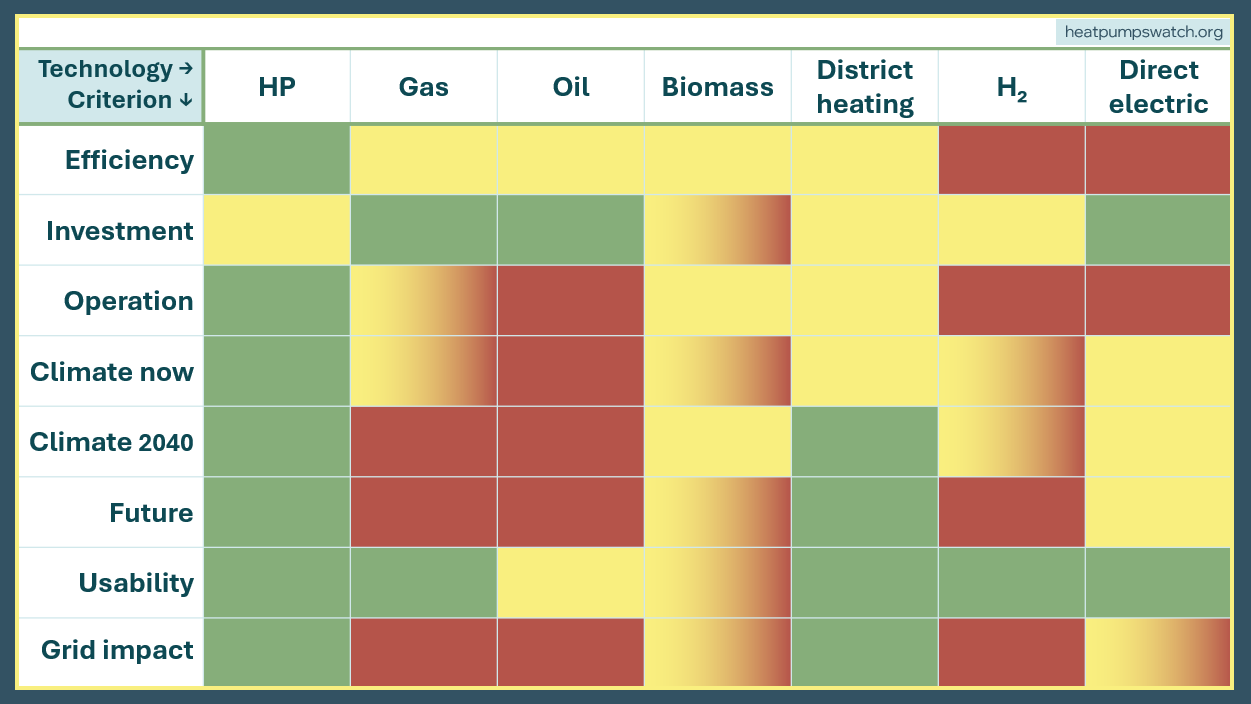
Never has the right path for replacing your heating system been so clear. It takes no heroic measures to act well for both climate and your own economy – choosing pragmatically is enough.
Choosing a heating system is one of the most consequential decisions a household can make. A new heating system typically lasts 15 to 20 years. During this time, energy costs add up to between €30,000 and €60,000, and cumulative CO₂ emissions can range from 30 to 80 tons per household, depending on the technology used – that’s equivalent to around 1,500 to 4,000 trees that would need to be planted and grow for 20 years to offset this amount. The decision made today will therefore have an impact until around 2045 – the year in which Germany is supposed to be climate neutral. The German heating market is undergoing radical change. The latest figures from the German Heating Industry Association (BDH) show a significant shift: in 2025, more heat pumps (299,000 units, +55%) were sold than gas boilers (229,000 units, −36%) for the first time. Sales of oil boilers fell by 74% to just 22,500 units. A total of 627,000 heat generators were sold – the lowest level in 15 years.1
There are many reasons for this development—political conditions, subsidy programs, rising CO₂ prices. But perhaps it simply reflects something fundamental: when people are faced with an important decision and take a close look at the options, they often choose the most pragmatic solution. A solution that makes economic sense, offers security for the future, and is good for the climate at the same time.
The Evaluation Matrix
The matrix as seen atop this page presented evaluates seven heating technologies based on eight criteria. The color scale ranges from green to yellow to red.
Explanation of the Evaluation Criteria
Efficiency
The criterion of efficiency describes how much usable heat is obtained from a unit of energy used. Heat pumps use ambient heat and typically generate 3 to 5 kWh of heat from 1 kWh of electricity. The actual efficiencies in everyday use were described in detail in Episode 2 of this series.2
Condensing boilers for gas and oil achieve efficiencies of 90 to 98% based on the calorific value. Pellet boilers achieve 85 to 95%. Direct electric heaters have an efficiency of 100% by definition (COP = 1), which makes them the most inefficient use of electricity for heating purposes.
Hydrogen as an energy source for heating purposes is particularly inefficient: first, green hydrogen must be produced by electrolysis (efficiency ~70%), then transported and stored (further losses), and finally burned in the boiler (efficiency ~90%). This means that 5–8 times more renewable energy is required in the overall chain than when used directly in a heat pump.3 This physical reality makes hydrogen systemically unsuitable for residential buildings.
Investment Costs
The investment costs include purchase, installation, and necessary peripherals.
An air-to-water heat pump typically costs €25,000 to €35,000 including installation, while a brine heat pump with geothermal drilling costs €35,000 to €45,000. Gas condensing boilers cost between €8,000 and €15,000, pellet boilers between €18,000 and €30,000, including storage space. Direct electric systems are the cheapest to purchase, costing between €3,000 and €8,000.
These price ranges are for guidance only. The actual costs may also fall outside these ranges, depending on the individual situation. The prices quoted refer to the German market – in other countries, the costs for heat pumps are usually lower.
Government subsidies (BEG) reduce the investment costs for heat pumps and biomass heating systems by 30 to 70%, depending on income and additional criteria. There are no longer any subsidies for fossil fuel systems.
Operating Costs
Operating costs include energy, maintenance, and foreseeable developments such as CO₂ pricing. Operating costs vary considerably between technologies. According to the 2025 heating index for Germany, the average annual heating costs for a 70 m² apartment in the 2024 billing year were around €1,030 for natural gas, €1,030 for heating oil, €1,225 for district heating, €680 for heat pumps, and €615 for wood pellets. For a typical single-family home with a heat requirement of 20,000 kWh (corresponding to approximately 140 m²), the costs are proportionally higher: A heat pump (SPF 3.5, heat pump tariff 25 ct/kWh) costs around €1,400 per year, a gas boiler (12 ct/kWh incl. CO₂ price) around €2,600, and an oil boiler around €3,000. CO₂ costs will continue to rise until the introduction of the EU Emissions Trading System II (ETS II).4567
Homeowners can use the free operating cost calculator at heatpumpswatch.org to get an individual calculation based on their own data.
Maintenance costs also vary: heat pumps require little maintenance (€50–150/year), gas boilers require annual maintenance and chimney sweep fees (€200–350/year), and pellet boilers have the highest maintenance costs (€300–500/year).
The operating costs for hydrogen are currently not foreseeable, but are likely to be significantly higher than those for natural gas.
Climate Impact Today
Actual greenhouse gas emissions with today’s electricity mix (Germany 2024: approx. 55% renewable).
Pellet heating systems are often considered climate-neutral in terms of their carbon footprint, but they emit around 20–80 g CO₂/kWh8 through combustion, transport, and processing. More importantly, biomass is only climate-neutral in the long term—the CO₂ released during combustion enters the atmosphere immediately, while it takes 20–80 years for it to be recaptured by renewable trees. In the critical period between now and 2030 and 2040, biomass combustion is therefore not climate-neutral.9
The CO₂ intensity of electricity varies considerably over the courses of years and even days. With a high feed-in of renewable energies, the operation of a heat pump can be virtually emission-free.
Climate Impact 2040
Compatibility with the 2040 energy system (80–90% renewable electricity generation according to German climate targets).
With an 80% share of renewables in the electricity mix, the CO₂ intensity of a heat pump falls to below 30 g CO₂/kWh—a level that is compatible with climate neutrality.10 Fossil fuels, on the other hand, have constant emission factors that cannot be reduced by system changes.
District heating can also achieve very low emissions with consistent decarbonization (large heat pumps, waste heat, solar thermal energy). The assessment depends heavily on the local generation structure.
Future Proofing
Will the investment still make regulatory, economic, and systemic sense in 15–25 years?
The Building Energy Act (GEG) stipulates that 65% of energy used in new buildings in new development areas must come from renewable sources from 2024 onwards.11 Existing fossil fuel heating systems may continue to be operated until 2044 at the latest. New oil heating systems are effectively banned, and new gas heating systems can only be installed under certain conditions. H₂-ready boilers promise a later conversion to hydrogen. However, a meta-analysis of 54 independent studies concludes that hydrogen is neither cost-efficient nor climate-friendly for residential buildings.12
An often-underestimated aspect of future security is independence from fossil fuels. While oil and gas have to be imported from politically unstable regions, the electricity for heat pumps can increasingly be generated locally from wind and solar power. Geopolitical conflicts over fossil fuels are likely to intensify in the coming decades – the energy transition is making Europe more independent.
Everyday-Use Suitability
Reliability, convenience, and maintenance requirements in everyday operation.
Gas boilers and district heating offer the highest level of convenience: low space requirements, no manual fuel feeding, low noise levels. Heat pumps are similarly convenient, but require an outdoor unit (note sound insulation). Pellet heating systems require storage space and regular ash removal.
Modern heat pumps operate at 35–55 dB(A) on the outdoor unit – comparable to a refrigerator or quiet conversation. If installed correctly and the distance rules are observed, this is usually not a problem.
System & Grid
Integration into the overall system of electricity, heating, and gas networks with millions of applications.
Heat pumps increase electricity demand, but can contribute to grid stabilization through intelligent control. The electricity grid is designed for further expansion. Gas networks, on the other hand, are expected to shrink, leading to rising network fees for remaining users. Green hydrogen in the building sector would require five to eight times more renewable electricity generation than direct electrification with heat pumps – an option that is hardly viable from a systemic perspective.13 The planned expansion of the hydrogen infrastructure focuses on industrial applications – residential areas are not included in hydrogen network planning.
Overview of the Technologies
Heat Pump
The heat pump scores green in 7 out of 8 criteria in the evaluation matrix, making it the most pragmatic and advantageous solution for most households.
It is by far the most efficient option. Although the investment costs are higher than for fossil fuel systems, this is offset by lower operating costs and subsidies. The heat pump already impresses in terms of operating costs, and the advantage continues to grow as CO₂ prices rise.
The climate impact is outstanding both today and in 2040 – with the increasing share of renewable energies, emissions will continue to fall. Future-proofing is maximized: no regulatory risks, no dependence on fossil fuel imports, fully compatible with the future energy system.
In terms of suitability for everyday use, heat pumps are hardly inferior to gas and district heating – modern comfort without manual intervention. In terms of system impact, they contribute to grid stabilization instead of burdening shrinking gas grids.
This assessment applies to all electric heating systems: the greener the electricity mix becomes, the better their climate balance – while fossil fuel systems always cause the same direct emissions.
Gas Boiler
Gas condensing boilers achieve efficiencies of 90–98% and are mature and convenient.
The assessment reveals a mixed picture: gas performs well in terms of investment costs and suitability for everyday use. However, it receives a negative rating in the future criteria (climate impact in 2040, future security, system & networks).
The reasons lie in the system logic: natural gas emits around 200 g CO₂/kWh when burned – a value that cannot be reduced through technical improvements. Rising CO₂ prices are continuously increasing operating costs. With the regulatory-enforced shrinkage of gas networks, network fees for remaining users are rising.
Oil Boiler
Oil condensing boilers function similarly to gas boilers, but emit even more CO₂ at 260–320 g/kWh.
In the assessment, oil heating receives a red rating in four out of eight criteria. The low investment costs are offset by high operating costs and low future security.
The massive decline in sales (minus 74% in 2025) reflects this assessment. New installations of oil heating systems have effectively been impossible since 2024; existing systems may continue to be operated until 2044 at the latest. For buildings that currently still use oil for heating, the question arises as to the optimal time to switch.
Biomass (Pellets)
Pellet heating systems burn compressed wood chips and are considered climate-neutral in terms of carbon footprint, as the wood burned has bound CO₂ during its growth. The reality is more nuanced.
This is problematic for short-term climate goals. Added to this are emissions from harvesting and transport. Biomass is not a widely scalable solution due to limited resources.
The assessment is therefore mixed. Biomass is particularly suitable for applications where local residues (sawmill waste, forest residues) are available and there is no competition for land. Due to limited resources, it is not a widely scalable solution for the entire building stock.
Practical aspects: Pellet boilers require storage space (approx. 6–8 m² for a year’s supply) and regular maintenance, including ash removal. They are less convenient than gas or heat pumps.
District Heating
District heating is not directly comparable – the external heat generator is decisive, not the device in the house. The house transfer station is compact and low-maintenance – the complexity lies in the network. The climate assessment of district heating depends heavily on the generation structure. Traditional networks often use combined heat and power with gas or coal. Modern networks increasingly rely on large heat pumps, waste heat from industry and data centers, and solar thermal energy. With consistent decarbonization, emission reductions of 64–70% can be achieved compared to fossil fuel networks.14
District heating offers systemic advantages: large heat pumps can supply many houses at once thanks to their capacity, central storage facilities can cushion peak loads, and the integration of different heat sources (waste heat, geothermal energy) is easier.
The limitation: district heating requires a network – either an existing one or the construction of new infrastructure. However, this network expansion is necessary and sensible for the heat transition in densely built-up areas. In densely built-up neighborhoods, district heating may even be the better option compared to decentralized heat pumps, as it is more efficient to develop and can use central large heat pumps or other heat sources. The investment decision lies with the municipality or the network operator, not with the individual homeowner.
H₂-ready-Heating
H₂-ready gas boilers can be converted to hydrogen after technical adjustments (hardware and software). They currently run on fossil gas. The scientific evidence is clear: hydrogen for residential buildings is neither efficient nor economical. The electricity requirement is five to eight times higher than for heat pumps.15
The availability of green hydrogen in the building sector is also highly uncertain. The limited amount is expected to be used in industry, aviation, and shipping, where no electrification alternatives exist. H₂-ready boilers can be seen as a kind of sedative: they allow the installation of a fossil fuel system with the promise of a later conversion. However, based on current knowledge, this promise cannot be kept. The assessment is therefore critical.
Direct-Electrical Heating
Direct electric heaters convert electricity directly into heat (COP = 1). Compared to heat pumps (COP 3–4), this means three to four times higher electricity consumption and correspondingly high operating costs. This leads to high operating costs and significant peak loads in the power grid. However, direct electric systems are justified for hot water production in certain applications—for example, as instantaneous water heaters in rarely used rooms or as a decentralized supplement.
Useful in niche areas: passive houses, rarely used rooms, hot water production in decentralized applications. Unsuitable as a primary heating system.
Supplementary Technologies
This comparison focuses on the main heating systems. Supplementary technologies such as solar thermal or photovoltaics were not evaluated individually, as they cannot cover the entire heating demand on their own. However, they are useful additions to several of the systems described and can significantly improve efficiency and cost-effectiveness. Hybrid systems that combine different technologies were described in detail in an earlier article of this series.
Conclusion
The systematic evaluation paints a clear picture: heat pumps and—where available—decarbonized district heating perform best in the overall assessment. Fossil fuel systems lose out significantly in terms of future criteria, even though they still have advantages in terms of investment costs and suitability for everyday use.
This result is in line with the scientific consensus. The studies analyzed by national and international research institutes, universities, and energy agencies all come to the same conclusion: heat pumps and decarbonized district heating are the main solutions for decarbonizing the building sector.
The analysis shows that the best solution for the climate, for independence from fossil fuel imports, and for the energy system of the future is also the most pragmatic for end users. This makes the transition easier.
Every household can make its own decision for its own reasons—but it is encouraging to see that the most sensible choice for the individual situation is so often also the best for the common good.
What the Evaluation Cannot Do
This analysis provides systematic guidance based on scientific evidence. For the vast majority of households, it leads to a clear recommendation: heat pump or, where available, decarbonized district heating. Of course, concrete implementation requires on-site consultation. Factors such as the exact condition of the building, the existing heating system, structural conditions, and personal priorities all play a role. But the basic direction is clear.
This article is part of our comprehensive series answering the 18 most important questions about heat pump technology. The series is organized into 6 thematic categories. Below you’ll find more articles from the same category, as well as the complete navigation to all other topics.
Technology & Systems
How heat pumps work, different system types, technological evolution, and refrigerant technology. From 20 years of progress to safety of natural refrigerants.

Episode 3: From Niche to Norm: 20 Years of Progress in Heat Pump Technology
Modern heat pumps: 10-15 dB quieter, 20% more efficient, and work up to 70°C—perfect for retrofits.

Episode 7: Hybrid Heat Pump Systems
Analysis reveals: Pure electric heat pumps outperform fossil hybrids in 95% of cases—lower costs, higher efficiency.

Episode 11: Between Air Conditioner and Heating System
Air-to-air heat pumps: lower installation costs, faster deployment, but different comfort level than water-based systems. Systemic comparison.

Episode 12: Heating Technologies Compared
Comprehensive comparison of all heating technologies: heat pumps, gas, hydrogen, biomass, and district heating – pragmatic decision framework.

Episode 16 (coming soon): Refrigerants
Refrigerant evolution: From R410A to natural refrigerants – environmental impact,
safety, and efficiency of modern solutions.
Foundations & Context
Why heat pumps matter for society, climate, and energy transition. Understand the big picture through social context, myth-busting, environmental impact analysis, and policy evaluation.
Episode 1: Beyond the Noise: What the Heat Pump Truly Means for Our Society
Why heat pumps are the fastest, most cost-effective path to energy independence – beyond political noise and fossil fuel myths.
Episode 4: The Heat Pumps Fact Check: Ten Myths Scientifically Disproven
Ten persistent myths scientifically debunked: heat pumps work in extreme cold, historic buildings, and with existing radiators.
Episode 17 (coming soon): Ecological viewpoint
Heat pumps reduce CO₂ emissions by 60-90% compared to gas heating. An environmental analysis.
Episode 18 (coming soon): Are Heat Pump Goals Achievable?
Achieving ambitious heat pump targets: Analysis of technical feasibility, economicviability, and political requirements for climate-neutral heating by 2045.
Economics & Costs
Operating expenses, installation costs, and long-term financial analysis. Real data on savings, price trends, and return on investment.
Episode 8: Operating Costs: Heat Pumps Already Outperform Gas Heating Systems Today
Save €400-1000/year compared to gas heating today – savings rise to €2,270/year by 2035. Interactive calculator included.
Episode 13: Heat Pump Installation Costs: Germany vs. Europe
German heat pump installations cost €20,000-40,000 – twice the European average. Analysis reveals why and what must change.
Real-World Performace
Field studies, efficiency measurements, and proven results. 20 years of data from 840+ installations in all building types.
Episode 2: 20 Years of Field Studies Prove: Heat Pumps Efficient in Existing Buildings
20 years of field research monitoring 840+ heat pumps in existing buildings. Latest studies show average efficiency (SPF) of 3.4 – even with radiators.
Episode 5: Efficiency Knows no Age: Heat Pumps in Buildings from 1826 to Present Day
6 case studies from 1826-1995: Unrenovated historic buildings achieve SPF 3.5-5.1 with proper planning and hydraulics.
Episode 6: Heat Pumps in Multi-Family Buildings: The Key to Urban Decarbonization
100+ documented cases prove heat pumps work in apartment buildings worldwide – centralized systems to individual units.
Planning & Implementation
Selecting, installing, and optimizing heat pumps for your needs. Practical guides from system sizing to installer selection.
Episode 9: Thousands of Heat Pumps Models on the Market: How to Find the Right One for Me?
Navigate 10,000+ certified heat pump models: Step-by-step guide from heating load calculation to installer selection and system commissioning.
Smart Integration
AI optimization, solar integration, and intelligent energy management. Next-generation heating systems that learn, adapt, and maximize efficiency.
Episode 10: Heat Pumps and AI: A Perfect Match?
AI-controlled heat pumps boost efficiency by 5-13%, reduce costs 40%, and support grid flexibility—research proven.
Episode 14: HEMS: Intelligent Control for Heat Pump Systems
Smart home energy management systems optimize heat pump operation, reduce costs by 15-25%, and enable grid services.
Episode 15: Heat Pumps as Energy Systems
How, with the help of PV, battery storages and electric cars, heat pumps become efficient complete systems. Analysis on savings, own production and bidirectional charging
- Bundesverband der Deutschen Heizungsindustrie (BDH): Sales Statistics Heating Systems 2025. Press release from February 1st, 2026. ↩︎
- Fraunhofer ISE: Wärmepumpen in Bestandsgebäuden – Results of the research project WPsmart im Bestand. Freiburg, 2020. / WP-QS Bestand: Feldtest 2022–2024. ↩︎
- Rosenow, J. et al.: Is heating homes with hydrogen sustainable? A meta-review of 54 studies. Cell Reports Sustainability, 2023. ↩︎
- co2online gGmbH: Heizspiegel für Deutschland 2025 – Vergleichswerte für das Abrechnungsjahr 2024. https://www.heizspiegel.de/heizkosten-pruefen/heizspiegel/ (Accessed in February, 2026). ↩︎
- Naumann, G.; Schropp, E.; Gaderer, M.: Life Cycle Assessment of an Air-Source Heat Pump and a Condensing Gas Boiler. Procedia CIRP, 105, 351–356, 2022. ↩︎
- Naumann, G.; Schropp, E.; Gaderer, M.: Environmental, economic, and eco-efficiency assessment of residential heating systems. Journal of Building Engineering, 98, 111074, 2024. ↩︎
- EWI – Energiewirtschaftliches Institut an der Universität zu Köln: A heated debate – The future cost-efficiency of climate-neutral heating technologies. Working Paper, 2024. ↩︎
- Aslan, K. et al.: A Comparative Environmental Assessment of Heat Pumps and Gas Boilers. MDPI Energies, 14(11), 3027, 2021. ↩︎
- IPCC AR6 Working Group III, Chapter 9: Buildings. Cambridge University Press, 2023. ↩︎
- Fraunhofer ISE: Wege zu einem klimaneutralen Energiesystem – Bundesländer im Transformationsprozess. REMod-Studie, 2024. ↩︎
- Gebäudeenergiegesetz (GEG) as of January 1st, 2024 ↩︎
- Rosenow, J. et al.: Is heating homes with hydrogen sustainable? A meta-review of 54 studies. Cell Reports Sustainability, 2023. ↩︎
- IEA – International Energy Agency: The Future of Heat Pumps. World Energy Outlook Special Report, Paris, 2022. ↩︎
- Bianchi, M. et al.: Decarbonization of district heating – A systematic review of carbon footprint and key mitigation strategies. Renewable and Sustainable Energy Reviews, 192, 2025. ↩︎
- Ueckerdt, F. et al.: Potential and risks of hydrogen-based e-fuels in climate change mitigation. Nature Climate Change, 11, 384–393, 2021. ↩︎