

Heat Pumps as Energy Systems
Those who install a heat pump have already made the pivotal decision. It utilizes ambient heat, operates efficiently, and significantly reduces CO₂ emissions compared to fossil fuel heating systems – while simultaneously providing protection against rising energy and CO₂ costs, which are expected to increase further. Photovoltaic systems, solar thermal energy, or an electric vehicle can serve as meaningful complements to this system.
Combining these technologies creates advantages that go beyond the mere sum of their individual contributions – albeit to varying degrees. Even without intelligent control, each component has its own benefits: the heat pump uses solar power from its own roof, a battery storage system extends this window of use, and the electric car prefers to charge when prices are low. One plus one equals two.
Only through active coordination – for example, via a home energy management system (HEMS), dynamic electricity tariffs, or discounted grid fees in accordance with Section 14a of the German Energy Industry Act (EnWG) – can these interactions be exploited in a targeted manner. The heat pump then runs more intensively when electricity generation is high or prices are low, the storage unit keeps capacity free, and the electric car becomes a mobile buffer. The result exceeds the mere sum of the individual contributions.
The HEMS, which was explained in Episode 14 of this series, is the central tool for this. However, it is not a prerequisite for the combinations described to pay off – they also work without intelligent coordination. With it, they unfold additional systemic added value.
Heat Pumps and Photovoltaics
The combination of a heat pump and a photovoltaic system is the most obvious and also the most widespread pairing in the field of building energy technology. The basic idea is simple: the PV system generates electricity on your own roof, and the heat pump uses it to provide heating and hot water. Instead of feeding surplus electricity into the grid at a feed-in tariff of currently around 8 cents per kilowatt hour, it is used in your own system – replacing grid electricity, which costs between 25 and 35 cents per kilowatt hour, depending on the tariff. The economic leverage lies in this difference.
How Much PV Electricity can the Heat Pump Actually Use?
The decisive limitation of this combination is the seasonal discrepancy: most solar radiation occurs in summer, but the highest heating demand is in winter. A heat pump that runs for many hours on cold days in January can only benefit to a limited extent from a PV system that generates little electricity on short, cloudy winter days. In summer, the picture is reversed: PV produces plenty of electricity, but the heat pump hardly heats at all. Domestic hot water production and active building cooling—an application that is gaining in importance—then absorb part of the surplus.
For context: Two key figures describe the success of this combination. Self-sufficiency indicates how much of the household’s electricity requirements are covered by its own generation; conversely, the self-consumption rate describes how much of the self-generated solar power is used in the home instead of flowing into the grid. Measurements show significant differences for both key figures depending on building efficiency, storage size, and usage behavior—with battery storage, both values increase significantly.1,2
A more specific key figure is decisive for the heat pump: the solar coverage ratio of the heat pump’s electricity demand – what percentage of the annual heat pump electricity comes from the building’s own PV production. This value is structurally significantly lower than the building-wide self-sufficiency and self-consumption values because the heat pump mainly needs its electricity in winter. In a typical existing building without battery storage, 15 to 20 percent is realistic. EUPD Research shows that building efficiency is the decisive lever here: the less the heat pump consumes annually, the higher the proportion that can be covered by solar energy.3
Dimensioning and Economic Viability
The PV system, heat pump, and storage unit should be dimensioned to work together.4 The dimensions should be based on the household’s total electricity consumption—including the heat pump, household electricity, and any electric cars. Oversizing does not result in proportional additional savings: surplus electricity flows into the grid and is remunerated at the current low feed-in tariff. A study by RWTH Aachen University and E.ON shows that the combination pays for itself in a typical existing building compared to fossil fuel heating – the exact time frame depends on building efficiency and the proportion of own consumption.5
Heat Pumps and Battery Storage
A battery storage system enables the decoupling of electricity generation and consumption over time: it charges during the day when the PV system is producing energy and releases the energy in the evening or at night – precisely when the heat pump is heating. According to BSW-Solar, eight out of ten newly installed PV roof systems in the residential segment are already being installed together with a battery storage system – the combination has long since become standard.6
In order for a battery storage system to deliver its full benefits, it needs predictive charge control.7 Without this control, a simply configured storage unit charges in the morning, is full to the brim at noon – and additional solar power flows into the grid instead of being used. A forecast-based control system takes weather forecasts into account and distributes the charging process throughout the day in such a way that capacity is kept free in a targeted manner. Design also plays a role: an oversized battery does not bring proportional additional savings. A storage capacity of about 1 to 1.5 kWh per kilowatt of PV power is a good guideline – more than that rarely pays for itself. The 2025 electricity storage inspection by HTW Berlin and KIT systematically investigated and documented this relationship.8
Battery storage systems also smooth out PV generation peaks and heat pump load peaks – providing measurable relief for the local power grid.9 A short study by HTW Berlin and BSW-Solar shows that intelligently combined systems consisting of PV, storage, and heat pumps can significantly reduce the need for grid expansion at the local level. Storage becomes particularly economical when a heat pump and an electric car are operated simultaneously in the household – this increases self-consumption and thus the benefits noticeably.10
Heat Pumps and Solar Thermics
Solar thermal energy is a mature technology: collectors on the roof convert solar radiation directly into usable heat with high efficiency and without the need for electricity. In combination with a heat pump, this creates a shared hydraulic installation in which both sources supply heat to the same heating system.
In practice, hot water production is the most common application. In summer, when solar thermal energy is most productive, the heat pump works efficiently for hot water production anyway – the heat source (outside air) is warm and the electricity requirement is low. Solar thermal energy therefore provides relief where it is least needed and is hardly available in winter, when demand is greatest. This seasonal shift is the key reason why the interaction of both technologies must be carefully planned.
Anyone who already has a solar thermal system should check whether it can be sensibly integrated into the new heat pump system. In many cases, this is technically possible and economically viable. When planning a new system, however, the decision is often made in favor of a photovoltaic system, as it is more flexible and, in combination with the heat pump, usually achieves a higher overall energy benefit.
Solar thermal energy thus remains a sensible solution for existing buildings, but is playing an increasingly subordinate role in new heat pump installations.
Heat Pumps and Electric Cars
Heat pumps and electric cars have one key thing in common: both are large, controllable electrical consumers. A heat pump in a single-family home typically requires 3,000 to 5,000 kWh of electricity per year, while an electric car requires an additional 2,000 to 3,000 kWh. A PV system with 8 to 10 kWp generates around 7,000 to 9,000 kWh year – enough for both consumers on an annual average. The decisive factor is not the annual balance, but the timing of generation and demand.
This potential can be tapped via charge control: when the car charges is largely flexible. Analyses of the savings potential show that the combination of intelligent charging management, dynamic electricity prices, and the reduced grid fees under Section 14a of the German Energy Industry Act (EnWG) can significantly reduce charging costs compared to uncontrolled charging – by 50 to over 80 percent in favorable constellations.11
Bidirectional Charging: The Electric Car as a Domestic Battery Storage
The forward-looking dimension lies in bidirectional charging – Vehicle-to-Home (V2H) and Vehicle-to-Grid (V2G). Modern electric cars have a battery capacity of 40 to 100 kWh – many times that of a home storage unit. A car charged by solar power during the day could supply the household, including the heat pump, in the evening. However, according to the German government, there is still a lack of cross-manufacturer standards for the interaction of bidirectional wallboxes, PV systems, storage units, heat pumps, and energy management.12 Standardized solutions are not expected until 2027/2028.13
Nevertheless, the market is starting to move. At the end of 2025, the German Bundestag eliminated the double burden of grid fees for temporary storage.14 In February 2026, BMW and E.ON launched the first commercial V2G offering for private customers.15 According to the German government, there are no known regulatory hurdles for V2H – the decisive factor is the availability of certified DC wallboxes from spring 2026.16
In a two-year practical test conducted by Hager Group, Audi, and E3/DC, households with PV and stationary battery storage achieved over 50 percent self-sufficiency. When the vehicle battery of a compatible electric vehicle was also integrated, this figure rose by up to nine percentage points. For the heat pump as a specific consumer, the solar coverage ratio of the heat pump’s electricity demand in V2H operation is a realistic 25 to 45 percent in a typical single-family home – and thus lower than that of a stationary battery storage system of the same capacity. During the day – precisely when the PV system produces the most – the electric car is often not at home. However, those who work from home or operate a second vehicle and regularly connect their car can increase this figure to 40 to 55 percent. The availability profile of the vehicle is therefore the most important single factor for the practical benefits of V2H in combination with a heat pump.17
The vehicle battery with 40 to 100 kWh is already available – there is no need for a separate investment in a large stationary storage unit. The relevant investment is the bidirectional wallbox: a standard wallbox costs between $500 and $1,500; bidirectional models currently start at $3,000 and up. The vehicle must be connected to be effective – those who use it during the day cannot use it as home storage at the same time. In addition, long-term data on battery aging due to increased discharging is still limited.
Heat Pumps and Fossil or Biogenic Heat Generators
For the sake of completeness, we should also mention the combination with a fossil fuel or biogenic heat generator—i.e., hybrid systems in which a gas boiler or pellet boiler supports the heat pump on particularly cold days. This topic was covered in detail in Episode 7 of this series. Unlike PV, battery storage, and electric cars, which increase the proportion of self-generated electricity or create flexibility, the fossil fuel boiler serves as a backup for very cold days – precisely when the heat pump’s output drops and the demand for heating is at its highest. Every hour of operation of the fossil fuel boiler increases CO₂ emissions, ties up fuel costs, and prolongs dependence on energy sources whose price development is difficult to predict. Anyone starting with a hybrid system should shift the bivalence point—the outside temperature at which the boiler switches on—as far as possible toward lower temperatures and replace the boiler in the medium term. As a permanent concept, the hybrid system does not have a convincing future perspective.
Heat Pumps and Thermal Storages
Thermal storage is not an addition to the heat pump—it is already present in most installations. A buffer tank for heating water, a hot water tank, or underfloor heating with its solid screed layer: these are all forms of thermal energy storage that can be used in a targeted manner. A standard buffer tank can hold several kilowatt hours of thermal energy – enough for several hours of heating in a well-insulated building. However, anyone who wants to store significant amounts of heat over several days will quickly reach their limits: this would require storage tanks of several cubic meters – which would be structurally complex and impractical for most existing buildings. Thermal storage is therefore well suited for short-term load shifting of a few hours, but not for seasonal storage.
This type of storage is most useful in combination with a PV system or a dynamic electricity tariff: when the PV system produces more than the household is currently consuming, or when electricity prices are particularly low, the heat pump is activated and the buffer storage tank or underfloor heating is set to a higher temperature setpoint. The heat stored in this way is available in the following hours without the heat pump requiring any further electricity. This principle of load shifting is at the heart of the SG-Ready interface, which was described in Episode 14 of this series.
A buffer tank is already part of the hydraulics in many heat pump systems, and the screed compound does not cost anything extra. Thermal load shifting is therefore the most cost-effective way to increase flexibility that a heat pump installation can offer. Please note: Raising the flow temperature too much increases the temperature rise of the heat pump and reduces its coefficient of performance – the benefits of load shifting must not outweigh the efficiency of ongoing operation.
The Complete System: When Several Components Operate Together
In practice, these combinations are increasingly being planned together. A household that decides to install a heat pump in 2026 will in many cases combine it with a PV system, battery storage, and an electric car from the outset.
According to a study by HTW Berlin, fully electrified households—heat pump, PV system, home storage, and electric car—achieve annual savings of up to €2,500.18 This figure exceeds the sum of the individual savings because the components reinforce each other: The storage system extends PV use into the night, the heat pump increases self-consumption, the electric car adds controllable load, dynamic tariffs reward flexibility – and HEMS coordinates the interaction. The same study shows that such combined systems can measurably reduce the need for local grid expansion.
For a single-family home with a heat pump, PV with battery storage is the most obvious first step in expansion. Those who also drive an electric car benefit disproportionately from dynamic tariffs – and, in the future, from bidirectional charging.
Explanations for the Infographic
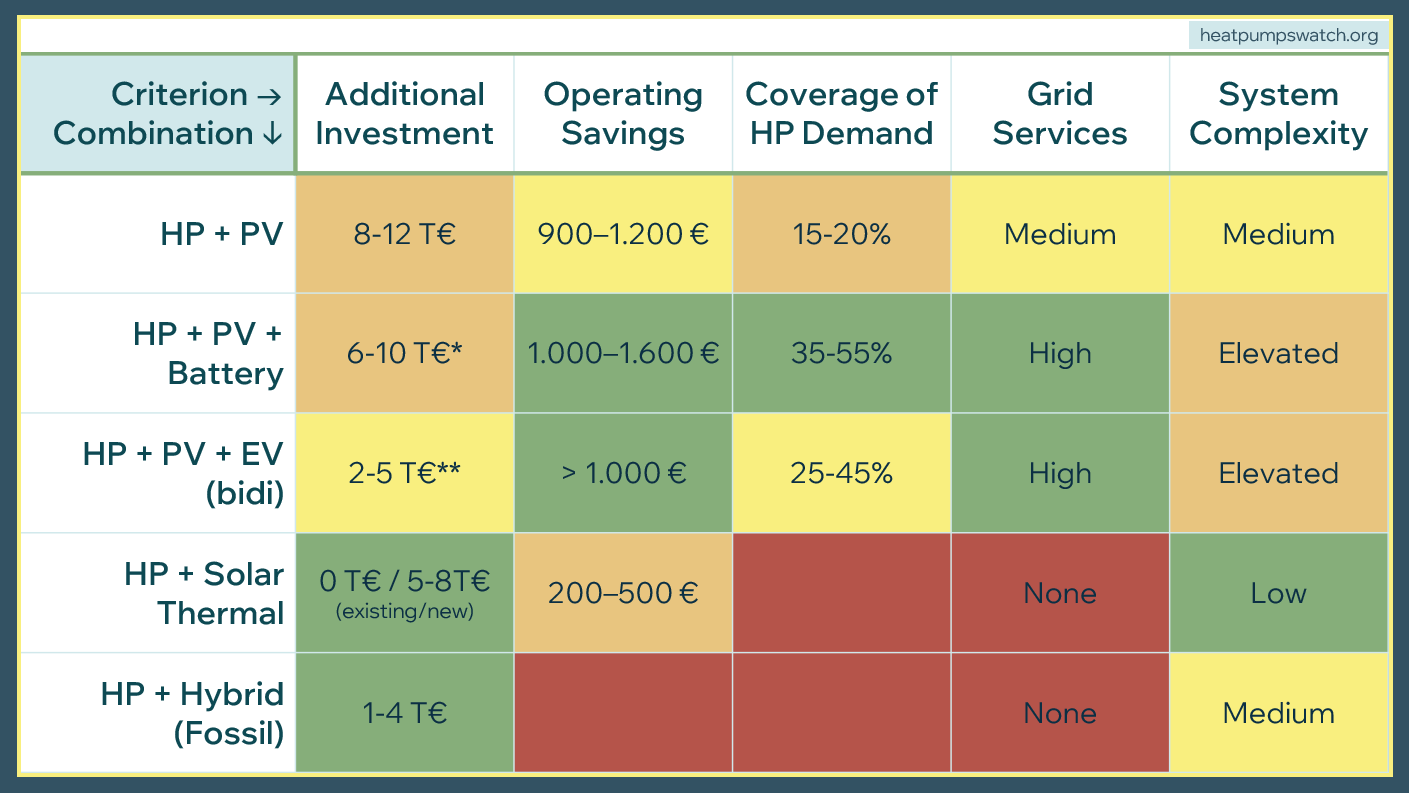
The graphic compares five combinations in five dimensions. “Solar self-sufficiency” shows the solar coverage ratio of the heat pump’s electricity requirements – not the household’s self-sufficiency. Reference: 140 m² single-family home, typical stock, heat pump electricity requirements approx. 5,000–6,000 kWh/year. Costs before subsidies.
HP + PV
Investment: €8,000–12,000 (PV share). Savings: €900–1,200/year (RWTH Aachen University/E.ON, 2024). HP coverage ratio: 15–20% (seasonal discrepancy between HP demand and PV yield). Grid: medium (SG-Ready). Complexity: medium.
HP + PV + battery storage
Investment: €6,000–10,000 (storage share, PV available). Savings: €1,000–1,600/year (HTW Berlin, 2025). Coverage ratio WP: 35–55% (depending on building; upper range with forecast-based HEMS). Grid: high. Complexity: increased (HEMS required).
Heat pump + solar thermal energy
Investment: ~€0 (existing) / €5–8k (new installation). Savings: €200–500/year. Heat pump coverage: n/a (no PV; indirectly reduces thermal heat pump demand). Grid: none. Complexity: low (hydraulic only).
WP + PV + electric car (bidirectional)
Investment: €2–5k (bidirectional wallbox; PV and vehicle already available). Savings: >€1,000/year (Neon study, 2025). WP coverage ratio: 25–45% (up to 55% with high vehicle availability). Grid: very high (V2G in the future). Complexity: increased (HEMS + bidirectional wallbox + ISO 15118; market launch in 2025/26).
WP + hybrid (fossil fuel)
€1–3 thousand | Additional costs possible | n/a | None | Medium
Summary
As Episode 12 of this series showed, the heat pump is the most efficient heating technology on the market in its own right – regardless of whether other components are added. Each of the additions described here contributes independently to economic efficiency and can be evaluated independently of the others.19 Photovoltaics provide inexpensive electricity for your own use. Battery storage extends the PV utilization window. Solar thermal energy relieves the heat pump when it comes to hot water production. Electric cars add controllable flexibility and, in the future, bidirectional storage potential. Dynamic tariffs and §14a grid fee discounts act as a financial amplifier for all combinations.
A home energy management system (HEMS) enhances all these combinations and unlocks synergies that would not arise without active coordination (see Episode 14). However, it is not a requirement – all the combinations described here work and pay off even without HEMS.
Those who consider multiple components from the outset can take advantage of synergies in planning, installation, and subsidies. Available subsidies—BEG for heat pumps, zero tax rate for PV and storage—significantly reduce investment costs. The heat pump is the core: what else is added depends on the building, budget, and living circumstances—but almost every addition pays off.
This article is part of our comprehensive series answering the 18 most important questions about heat pump technology. The series is organized into 6 thematic categories. Below you’ll find more articles from the same category, as well as the complete navigation to all other topics.
Smart Integration
AI optimization, solar integration, and intelligent energy management. Next-generation heating systems that learn, adapt, and maximize efficiency.

Episode 10: Heat Pumps and AI: A Perfect Match?
AI-controlled heat pumps boost efficiency by 5-13%, reduce costs 40%, and support grid flexibility—research proven.

Episode 14: HEMS: Intelligent Control for Heat Pump Systems
Smart home energy management systems optimize heat pump operation, reduce costs by 15-25%, and enable grid services.
Episode 15: Heat Pumps as Energy Systems
How, with the help of PV, battery storages and electric cars, heat pumps become efficient complete systems. Analysis on savings, own production and bidirectional charging
Foundations & Context
Why heat pumps matter for society, climate, and energy transition. Understand the big picture through social context, myth-busting, environmental impact analysis, and policy evaluation.
Episode 1: Beyond the Noise: What the Heat Pump Truly Means for Our Society
Why heat pumps are the fastest, most cost-effective path to energy independence – beyond political noise and fossil fuel myths.
Episode 4: The Heat Pumps Fact Check: Ten Myths Scientifically Disproven
Ten persistent myths scientifically debunked: heat pumps work in extreme cold, historic buildings, and with existing radiators.
Episode 17 (coming soon): Ecological viewpoint
Heat pumps reduce CO₂ emissions by 60-90% compared to gas heating. An environmental analysis.
Episode 18 (coming soon): Are Heat Pump Goals Achievable?
Achieving ambitious heat pump targets: Analysis of technical feasibility, economicviability, and political requirements for climate-neutral heating by 2045.
Technology & Systems
How heat pumps work, different system types, technological evolution, and refrigerant technology. From 20 years of progress to safety of natural refrigerants.
Episode 3: From Niche to Norm: 20 Years of Progress in Heat Pump Technology
Modern heat pumps: 10-15 dB quieter, 20% more efficient, and work up to 70°C—perfect for retrofits.
Episode 7: Hybrid Heat Pump Systems
Analysis reveals: Pure electric heat pumps outperform fossil hybrids in 95% of cases—lower costs, higher efficiency.
Episode 11: Between Air Conditioner and Heating System
Air-to-air heat pumps: lower installation costs, faster deployment, but different comfort level than water-based systems. Systemic comparison.
Episode 12: Heating Technologies Compared
Comprehensive comparison of all heating technologies: heat pumps, gas, hydrogen, biomass, and district heating – pragmatic decision framework.
Episode 16 (coming soon): Refrigerants
Refrigerant evolution: From R410A to natural refrigerants – environmental impact, safety, and efficiency of modern solutions.
Economics & Costs
Operating expenses, installation costs, and long-term financial analysis. Real data on savings, price trends, and return on investment.
Episode 8: Operating Costs: Heat Pumps Already Outperform Gas Heating Systems Today
Save €400-1000/year compared to gas heating today – savings rise to €2,270/year by 2035. Interactive calculator included.
Episode 13: Heat Pump Installation Costs: Germany vs. Europe
German heat pump installations cost €20,000-40,000 – twice the European average. Analysis reveals why and what must change.
Real-World Performace
Field studies, efficiency measurements, and proven results. 20 years of data from 840+ installations in all building types.
Episode 2: 20 Years of Field Studies Prove: Heat Pumps Efficient in Existing Buildings
20 years of field research monitoring 840+ heat pumps in existing buildings. Latest studies show average efficiency (SPF) of 3.4 – even with radiators.
Episode 5: Efficiency Knows no Age: Heat Pumps in Buildings from 1826 to Present Day
6 case studies from 1826-1995: Unrenovated historic buildings achieve SPF 3.5-5.1 with proper planning and hydraulics.
Episode 6: Heat Pumps in Multi-Family Buildings: The Key to Urban Decarbonization
100+ documented cases prove heat pumps work in apartment buildings worldwide – centralized systems to individual units.
Planning & Implementation
Selecting, installing, and optimizing heat pumps for your needs. Practical guides from system sizing to installer selection.
Episode 9: Thousands of Heat Pumps Models on the Market: How to Find the Right One for Me?
Navigate 10,000+ certified heat pump models: Step-by-step guide from heating load calculation to installer selection and system commissioning.
- Fraunhofer ISE (2025): Wärmepumpen heizen auch im Altbau klimafreundlich – Research project completed. Field data of 77 heat pumps in single, double, and triple family homes. Freiburg, November 2025. ↩︎
- Fraunhofer ISE (2024): Analysis of the performance and operation of a photovoltaic-battery heat pump system based on field measurement data. In: Solar Energy Advances, April 2024. ↩︎
- EUPD Research (2022): Solare Deckungsgrade für den Strombedarf von Wärmepumpen in Ein- und Zweifamilienhäusern. In: pv magazine Deutschland, 28th October 2022. ↩︎
- BDH – Bundesverband der Deutschen Heizungsindustrie (2024): Informationsblatt Nr. 70 – Planung und Auslegung des Systems PV-Anlage, Wärmepumpe und Speicherung. Berlin 2024. ↩︎
- RWTH Aachen / E.ON (2024): Wirtschaftlichkeit der Kombination Wärmepumpe und Photovoltaik in Bestandsgebäuden. Studie, 2024. ↩︎
- BSW-Solar / HTW Berlin (2025): Poll among installation businesses. Berlin, December 2025. ↩︎
- HTW Berlin – Forschungsgruppe Solarspeichersysteme (2025): Battery storage inspection 2025. Berlin, February 2025. ↩︎
- HTW Berlin – Forschungsgruppe Solarspeichersysteme (2025): Empfehlungen zur Auslegung von Solarstromspeichern. Berlin 2025. ↩︎
- HTW Berlin / BSW-Solar (2025): Reduktion des Netzausbaubedarfs durch Prosuming. Short study. Berlin, December 2025 ↩︎
- HTW Berlin (2025): Speicherinspektion 2025 – Einsparpotenziale für Eigenheime mit Wärmepumpe und Elektroauto. Computation on the base of a 10-kWp-PV-system, 10-kWh battery storage, heat pump and electric cars in a single family home. Berlin 2025. ↩︎
- Neon Neue Energieökonomik (2025): Einsparpotenzial für Haushalte durch dynamische Stromtarife. Study commissioned by naturstrom AG. Berlin, October 2025. ↩︎
- Deutscher Bundestag (2025): Antwort der Bundesregierung zum bidirektionalen Laden. Drucksache 20/14985. Berlin, February 2025. ↩︎
- VDE FNN (2024): Hinweis Bidirektionales Laden – Laden und Rückspeisen von Elektrofahrzeugen. Frankfurt 2024 ↩︎
- Bundesregierung (2025): Beschluss zur Beseitigung der Doppelbelastung bei Netzentgelten und Stromsteuer für Zwischenspeicherung. Berlin, November 2025. ↩︎
- BMW / E.ON (2026): Gemeinsames Marktangebot für bidirektionales Laden mit BMW Neue Klasse. Press release, February 2026. ↩︎
- SFV – Solarenergie-Förderverein Deutschland (2025): Bidirektionales Laden in Deutschland – Status Quo 2025. Aachen 2025. ↩︎
- Hager Group / Audi / E3/DC (2024): Bidirektionales Laden im Alltag – Zweijähriger Praxistest. Published on: firmenauto.de, November 2025 ↩︎
- HTW Berlin (2025): Speicherinspektion 2025 – Einsparpotenziale für Eigenheime mit Wärmepumpe und Elektroauto. Berlin 2025. ↩︎
- BWP – Bundesverband Wärmepumpe (2025): Sales statistic heat pumps 2025. Berlin 2025. ↩︎