

Between Air Conditioner and Heating System
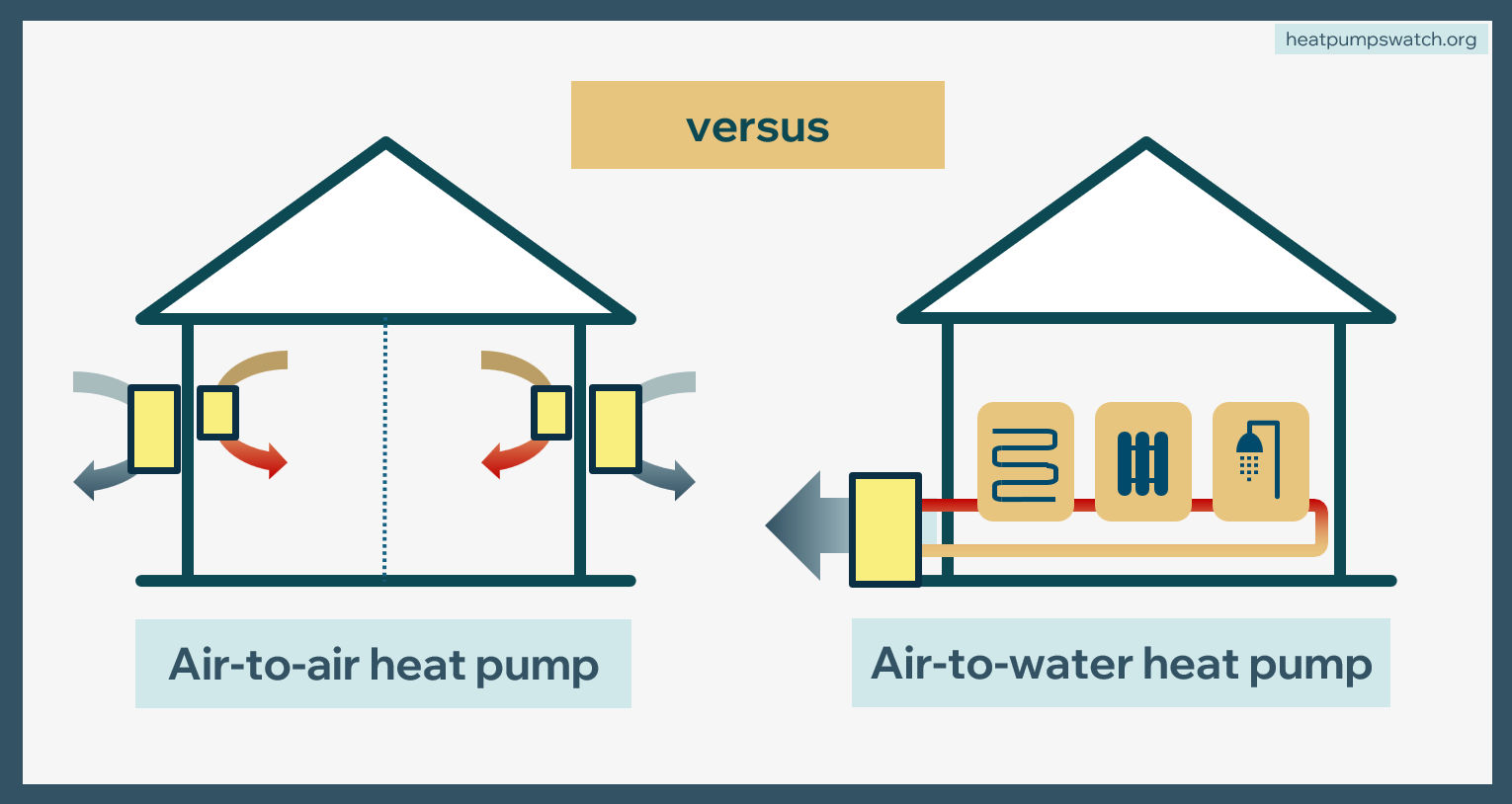
The designation of a heat pump immediately reveals which heat source the heat pump uses and which heat sink it can serve. Air-to-water heat pumps use outside air (in most cases) as their heat source and a water-based system (underfloor heating or radiators) as their heat sink. Air-to-air heat pumps, on the other hand, distribute heat (or cooling) into the room via the air.
These types of heat pumps are often discussed as a cost-effective alternative to water-based systems. They offer several clear advantages: lower acquisition costs, simple installation without hydraulic modifications, and an integrated cooling function. They are widely used and dominate the market in countries such as Norway, Sweden, and Asian countries.
In Germany, however, they have played a very minor role to date. The statistics of the German Heat Pump Association do not even record them separately. This article highlights the applications for which air-to-air heat pumps can be a sensible solution and the practical aspects that should be considered when making a decision.
The key question is: Is the air-to-air heat pump a good alternative for all houses—or only for certain applications?
What is an Air-to-Air Heat Pump?
An air-to-air heat pump extracts heat from the outside air and transfers it directly to the indoor air via an indoor unit. In the case of cooling, the process is reversed: the system extracts heat from the indoor air and transfers it to the outside air. Unlike air-to-water heat pumps, no water circuit is used for heat distribution. The system consists of an outdoor unit and one or more indoor units connected by refrigerant pipes.
From a technical point of view, most air-to-air heat pumps are air conditioning units (split air conditioning systems) that have a heating function in addition to a cooling function. In countries with a high demand for cooling, these units are primarily sold and used as air conditioners, while in colder regions the heating function is the main focus.
The most common system variants are split units (one outdoor unit, one indoor unit), multi-split systems (one outdoor unit, several indoor units) and VRF (Variable Refrigerant Flow) systems for larger buildings.
The Japanese company Mitsubishi Electric developed the first mini-split system in 1959. From there, the technology spread first in Asia and later worldwide – with the exception of countries such as Germany, where water-based central heating systems were already established.
International Market Stats
In Germany, around 193,000 heating heat pumps were sold in 2024, 92% of which were air-to-water systems – air-to-air heat pumps are not recorded separately in statistics.1
In Norway, on the other hand, air-to-air systems dominate with a market share of over 75%; Since 1987, a total of 1.9 million heat pumps have been sold, corresponding to a density of 632 units per 1,000 households – the highest figure worldwide.23
In Japan, over 90% of households are equipped with mini-split systems, which are considered the standard solution for heating and cooling there.4
Technical Comparison: Air-to-Air vs. Air-to-Water
The two types of systems differ fundamentally in the way they distribute heat. While air-to-air heat pumps blow the heated air directly into the room, air-to-water systems use a water circuit to distribute the heat to radiators or underfloor heating systems. These differences have far-reaching consequences for the possible applications: Air-to-air systems cannot produce domestic hot water (DHW) due to their design, but offer a cooling function as standard. They can be installed without hydraulic modifications to the existing building, while air-to-water systems require a water-based distribution system.
| Feature | Air-to-Air | Air-to-Water |
| Heat distribution | Directly via airflow | Via water to radiator / underfloor heating |
| Domestic Hot Water | Not possible | Integrated |
| Cooling | Built-in function | Possible, higher effort |
| Integration into existing structure | Without hydraulic changes | Requires water-bases system |
The Question of Domestic Hot Water
The lack of hot water production is one of the main limitations of air-to-air heat pumps. This limitation is inherent to the system and lies in the nature of a system that transfers heat directly to the room air and does not use a water circuit.
Separate solutions must therefore be planned for hot water production: a separate domestic hot water heat pump, a direct electric solution such as a continuous-flow water heater – possibly supported by solar thermal energy – or, as a temporary transitional solution, the continued use of an existing fossil fuel boiler exclusively for hot water production.
When planning an air-to-air solution, the hot water concept must be considered from the outset. The total costs and economic efficiency depend largely on which solution is chosen.
Efficiency: Why Measurements are so Difficult
With air-to-water heat pumps, the heat emitted can be precisely measured using heat meters in the water circuit. The seasonal performance factor (SPF) is calculated as the quotient of heat supplied and electrical energy consumed.
With air-to-air systems, this is almost impossible under field conditions. The heat distributed via the room air can hardly be quantified. There is no water circuit in which a heat meter could be installed and no air supply ducts that would also have enabled heat measurement. For this reason, there are no systematic field studies for air-to-air heat pumps in heating mode, as there are for air-to-water systems.
Manufacturers specify COP (coefficient of performance) values of approx. 3.0 to 4.5 under standardized laboratory conditions. The actual seasonal performance factor in the field remains largely unknown due to the lack of measurement options.
In theory, air-to-air systems could operate more efficiently than air-to-water systems, as they could operate at lower flow temperatures. The room air typically only needs to be heated to 20–25°C. In practice, however, heat transfer with air is poorer than with water, which means that the heat pump has to heat the air to similar (compared to radiators) or even higher (compared to underfloor heating) temperatures than water-based systems. As a result, the real efficiency of air-to-air heat pumps should be comparable to that of air-to-water heat pumps. However, there is a lack of data to confirm these theoretical expectations.
For air-to-water heat pumps, field studies provide clear findings: seasonal performance factor (SPF) of 2.5 to 4.5, averaging 3.1 to 3.4 – even in existing buildings with radiators.
National Differences
The varying prevalence of air-to-air heat pumps can be explained less by climatic factors than by historically developed building infrastructure and cultural heating habits.5
Norway: No tradition of water-based heating systems. Historically, direct electric heating has dominated, favored by cheap hydroelectric power (98% renewable). The oil crisis of the 1970s accelerated the switch to heat pumps. Today, there are 632 heat pumps installed per 1,000 households – the highest figure worldwide.6 Of these, approximately 75% are air-to-air systems.
Japan: Room-by-room heating and cooling is the cultural norm. The traditional lightweight construction of Japanese houses was never designed for central heating. Mini-split systems are perfectly suited to this type of use. Over 90% of households are equipped with them. Only in cold regions such as Hokkaido can houses with water-based systems be found.
Germany: Water-based central heating systems have been the standard for decades. The cultural expectation of uniform room temperatures throughout the house favors systems with central heat distribution. The subsidy structure has also historically been geared toward water-based systems.
Real-Life Aspects
Aside from the technical differences, there is a bandwidth of practical aspects that need to be considered when it comes to deciding in favor of or against an air-to-air heat pump. They concern both the daily operations of the heat pumps and how it functions in the long run.
Heat Distribution inside the Building
When only individual rooms are heated, temperature differences inevitably arise within the building. Hallways, stairwells, and adjoining rooms remain cooler than the heated main rooms. This can not only cause discomfort, but also have consequences for the building’s structure: moisture from the warmer air in the room can condense on cold wall surfaces and thermal bridges, which in the worst case can lead to mold growth and structural damage.
Airflow and Draft Sensation
A key difference to water-based systems is the type of heat transfer: air-to-air heat pumps heat the room by moving air that flows out of the indoor unit. This air movement can be perceived as a draft, especially when people are sitting directly in the air stream. Although modern devices offer various airflow modes and swiveling louvers, the noticeable air movement is still a characteristic feature of this technology. In water-based systems with radiators or underfloor heating, on the other hand, heat transfer occurs mainly through radiation and natural convection, without actively moving air.
System Complexity
Supplying an entire house with air-to-air heat pumps requires several indoor units—typically one per main room. With split systems, this also means several outdoor units. Multi-split systems reduce the number of outdoor units, but require refrigerant lines to be laid to each indoor unit.
Servicing
Each indoor unit has air filters that need to be cleaned regularly. Manufacturers recommend cleaning them every two weeks if used frequently; in living environments with less dust, a monthly interval may be sufficient7. In a house with several indoor units, this effort is multiplied accordingly.
Acoustics
Modern indoor units operate at 19–30 dB(A) – quieter than a refrigerator. Nevertheless, the operating noise is noticeable, especially in quiet environments such as bedrooms. People react differently to continuous background noise; for some, even a quiet but constant airflow noise can be disturbing.
Outdoor units reach 40–60 dB(A), comparable to light rain or normal conversation. With multiple outdoor units, you have to expect multiple sound sources.
Optics
Multiple outdoor units on the facade of a building are visually conspicuous and can detract from the appearance of a building. This is an aspect that can be accepted or mitigated through clever placement and architectural solutions—such as cladding, greening, or integration into less visible areas.
Usage in Multi-Family Buildings
Multi-family buildings account for a significant proportion of the urban building stock – 48 percent of the European population lives in multi-family buildings.8 Their successful decarbonization is therefore crucial to the success of the urban heat transition.
The dena practical guide for heat pumps in multi-family buildings presents various system options – from centralized to decentralized solutions9. For multi-family buildings with decentralized heat supply – especially those with gas floor heating, which account for around 18 percent of the stock – air-to-air heat pumps can be an attractive option.
Practical example: LEG Immobilien. Since 2022, LEG Immobilien SE has been testing the use of air-to-air heat pumps as a replacement for gas floor heating.
The technical implementation is carried out with multi-split devices. The costs are between €10,000 and €12,000 per apartment, including electrical installation and hot water solution1011. Installation takes one to two days per apartment. According to the operator, the feedback so far has been positive – however, further independent long-term experience should be awaited.12
Summary Assessment
When choosing between air-to-air and air-to-water heat pumps, it is not a question of which system is objectively “better” – both technologies have their merits. The decisive factor is rather which system is best suited to the individual situation, the building, and the needs of the users.
The following table summarizes the main advantages and limitations of air-to-air heat pumps to provide a quick overview. It is not a substitute for individual advice, but it can help you identify the relevant aspects for your own decision.
| Advantages | Limitations |
| Lower acquisition cost | No Domestic Hot Water |
| No hydraulic changes required in the existing structure | Multiple devices required for whole-house supply |
| Built-in cooling function as standard | Danger of uneven heat distributions |
| Quick installation (1-2 days) | Noticable airflow / possible sensation of draft |
| Ideal or buildings without water-bases systems | More servicing effort (filter cleaning) |
| Well-tested in cold climate zones (Scandinavia) | Audible operating noise inside |
| Few field studies about real-life efficiency available | |
| Visual impairment caused by multiple outdoor units |
Situations in which Air-to-Air Heat Pumps Are Suitable
This technology is particularly interesting for houses whose low heat requirements can be easily met with individual indoor units. Buildings that were previously heated with direct electric heating (night storage heaters, fan heaters) and do not have a water circuit also benefit from the uncomplicated installation without hydraulic modifications.
For supplementary heating of individual rooms—such as a retrofitted attic or a conservatory—a split unit offers a pragmatic solution without having to expand the existing heating system. In apartment buildings with decentralized supply, especially as a replacement for gas floor heating, installation in individual apartments allows for a gradual conversion without costly building modifications.
Last but not least, the technology is attractive for users who, in addition to heating, also have high cooling requirements in summer – the cooling function is integrated as standard and does not incur any additional investment costs.
Situations in which Air-to-Water Heat Pumps Are Preferable
Air-to-air heat pumps are less suitable for unrenovated old buildings with high heat requirements. In such buildings, a large number of indoor units would be required to adequately heat all rooms – which increases both costs and complexity and negates the original cost advantage.
Switching to an air-to-air system is also not usually a good idea for buildings that already have a functioning water-based heating system with radiators or underfloor heating. In this case, an air-to-water heat pump offers the possibility of continuing to use the existing infrastructure while also integrating hot water production.
Households with high hot water requirements—such as families with several children—should bear in mind that a separate hot water solution entails additional costs and complexity. And those who value consistent room temperatures throughout the house and are sensitive to air movement may be happier with a water-based system and radiant heat.
Conclusion
Air-to-air heat pumps are a legitimate solution for certain applications. They offer clear advantages in terms of investment costs, installation speed, and integrated cooling function. At the same time, they have clear limitations: no hot water production, potentially uneven heat distribution, noticeable air movement in the room, and a lack of field data on real-world efficiency.
International experience—for example, from Scandinavia or Japan—shows that this technology also works in cold climates. The differences in prevalence can be explained less by climatic factors than by historically developed building infrastructure and cultural heating habits.
Before making a decision, a few key questions should be clarified: How should the hot water be heated? Is uniform heating of the entire house without noticeable air movement expected? And is there already a functioning water-based heating system in place that would make investing in a new distribution system unnecessary?
Regardless of which solution you choose, the following applies: A heat pump system should always be planned and installed by qualified specialists.
This article is part of our comprehensive series answering the 18 most important questions about heat pump technology. The series is organized into 6 thematic categories. Below you’ll find more articles from the same category, as well as the complete navigation to all other topics.
Technology & Systems
How heat pumps work, different system types, technological evolution, and refrigerant technology. From 20 years of progress to safety of natural refrigerants.

Episode 3: From Niche to Norm: 20 Years of Progress in Heat Pump Technology
Modern heat pumps: 10-15 dB quieter, 20% more efficient, and work up to 70°C—perfect for retrofits.

Episode 7: Hybrid Heat Pump Systems
Analysis reveals: Pure electric heat pumps outperform fossil hybrids in 95% of cases—lower costs, higher efficiency.

Episode 11: Between Air Conditioner and Heating System
Air-to-air heat pumps: lower installation costs, faster deployment, but different comfort level than water-based systems. Systemic comparison.

Episode 12: Heating Technologies Compared
Comprehensive comparison of all heating technologies: heat pumps, gas, hydrogen, biomass, and district heating – pragmatic decision framework.

Episode 16 (coming soon): Refrigerants
Refrigerant evolution: From R410A to natural refrigerants – environmental impact,
safety, and efficiency of modern solutions.
Foundations & Context
Why heat pumps matter for society, climate, and energy transition. Understand the big picture through social context, myth-busting, environmental impact analysis, and policy evaluation.
Episode 1: Beyond the Noise: What the Heat Pump Truly Means for Our Society
Why heat pumps are the fastest, most cost-effective path to energy independence – beyond political noise and fossil fuel myths.
Episode 4: The Heat Pumps Fact Check: Ten Myths Scientifically Disproven
Ten persistent myths scientifically debunked: heat pumps work in extreme cold, historic buildings, and with existing radiators.
Episode 17 (coming soon): Ecological viewpoint
Heat pumps reduce CO₂ emissions by 60-90% compared to gas heating. An environmental analysis.
Episode 18 (coming soon): Are Heat Pump Goals Achievable?
Achieving ambitious heat pump targets: Analysis of technical feasibility, economicviability, and political requirements for climate-neutral heating by 2045.
Economics & Costs
Operating expenses, installation costs, and long-term financial analysis. Real data on savings, price trends, and return on investment.
Episode 8: Operating Costs: Heat Pumps Already Outperform Gas Heating Systems Today
Save €400-1000/year compared to gas heating today – savings rise to €2,270/year by 2035. Interactive calculator included.
Episode 13: Heat Pump Installation Costs: Germany vs. Europe
German heat pump installations cost €20,000-40,000 – twice the European average. Analysis reveals why and what must change.
Real-World Performace
Field studies, efficiency measurements, and proven results. 20 years of data from 840+ installations in all building types.
Episode 2: 20 Years of Field Studies Prove: Heat Pumps Efficient in Existing Buildings
20 years of field research monitoring 840+ heat pumps in existing buildings. Latest studies show average efficiency (SPF) of 3.4 – even with radiators.
Episode 5: Efficiency Knows no Age: Heat Pumps in Buildings from 1826 to Present Day
6 case studies from 1826-1995: Unrenovated historic buildings achieve SPF 3.5-5.1 with proper planning and hydraulics.
Episode 6: Heat Pumps in Multi-Family Buildings: The Key to Urban Decarbonization
100+ documented cases prove heat pumps work in apartment buildings worldwide – centralized systems to individual units.
Planning & Implementation
Selecting, installing, and optimizing heat pumps for your needs. Practical guides from system sizing to installer selection.
Episode 9: Thousands of Heat Pumps Models on the Market: How to Find the Right One for Me?
Navigate 10,000+ certified heat pump models: Step-by-step guide from heating load calculation to installer selection and system commissioning.
Smart Integration
AI optimization, solar integration, and intelligent energy management. Next-generation heating systems that learn, adapt, and maximize efficiency.
Episode 10: Heat Pumps and AI: A Perfect Match?
AI-controlled heat pumps boost efficiency by 5-13%, reduce costs 40%, and support grid flexibility—research proven.
Episode 14: HEMS: Intelligent Control for Heat Pump Systems
Smart home energy management systems optimize heat pump operation, reduce costs by 15-25%, and enable grid services.
Episode 15: Heat Pumps as Energy Systems
How, with the help of PV, battery storages and electric cars, heat pumps become efficient complete systems. Analysis on savings, own production and bidirectional charging
- Bundesverband Waermepumpe (BWP) / Bundesverband der Deutschen Heizungsindustrie (BDH): Sales statistics heat pumps 2024. Press release dated January 23, 2025. ↩︎
- Norwegian Heat Pump Association (NOVAP): Sales Statistics 2024. In: Heat Pumping Technologies (HPT), Vol. 43, No. 2, 2025. ↩︎
- European Heat Pump Association (EHPA): Market Data 2025. Online: ehpa.org/market-data/ (Abruf: Januar 2026). ↩︎
- INABA DENKO: Air conditioning situation in Japan. Technical Report, 2024 ↩︎
- Miara, M.; Guenther, D. et al.: Waermepumpen in Bestandsgebaeuden. Results from the research project WPsmart im Bestand. Fraunhofer ISE, Freiburg, 2020. ↩︎
- International Energy Agency (IEA): Norway 2022 Energy Policy Review. Paris, 2022. ↩︎
- Klivatec: Anleitung zur Filterreinigung bei Wandklimageraeten, April 2025; Hitachi: Filterwartung am Klimageraet, 2025. ↩︎
- Miara, M. (2022): Heat Pumps in Multi-Family Buildings for Space Heating and Domestic Hot Water. Final Report Annex 50, HPT-AN50-1. Technology Collaboration Programme on Heat Pumping Technologies, S. 14-15. ↩︎
- Deutsche Energie-Agentur (dena): Praxisleitfaden fuer Waermepumpen in Mehrfamilienhaeusern. Status quo. Erfahrungen. Moeglichkeiten. Berlin, Maerz 2024, S. 8-12. ↩︎
- LEG Immobilien SE: Luft-Luft-Waermepumpen-Offensive. Unternehmensmitteilung, Juli 2024. ↩︎
- Gebaeudeforum klimaneutral / Deutsche Umwelthilfe: Von der Gas-Etagenheizung zur Waermepumpe. Best Practice Dokumentation, 2024. ↩︎
- dekarbo GmbH: Gesamtloesung fuer die Dekarbonisierung von Mietwohnungen. Product information, 2024. ↩︎